

Don’t Let the Buyer Move In Before You Close
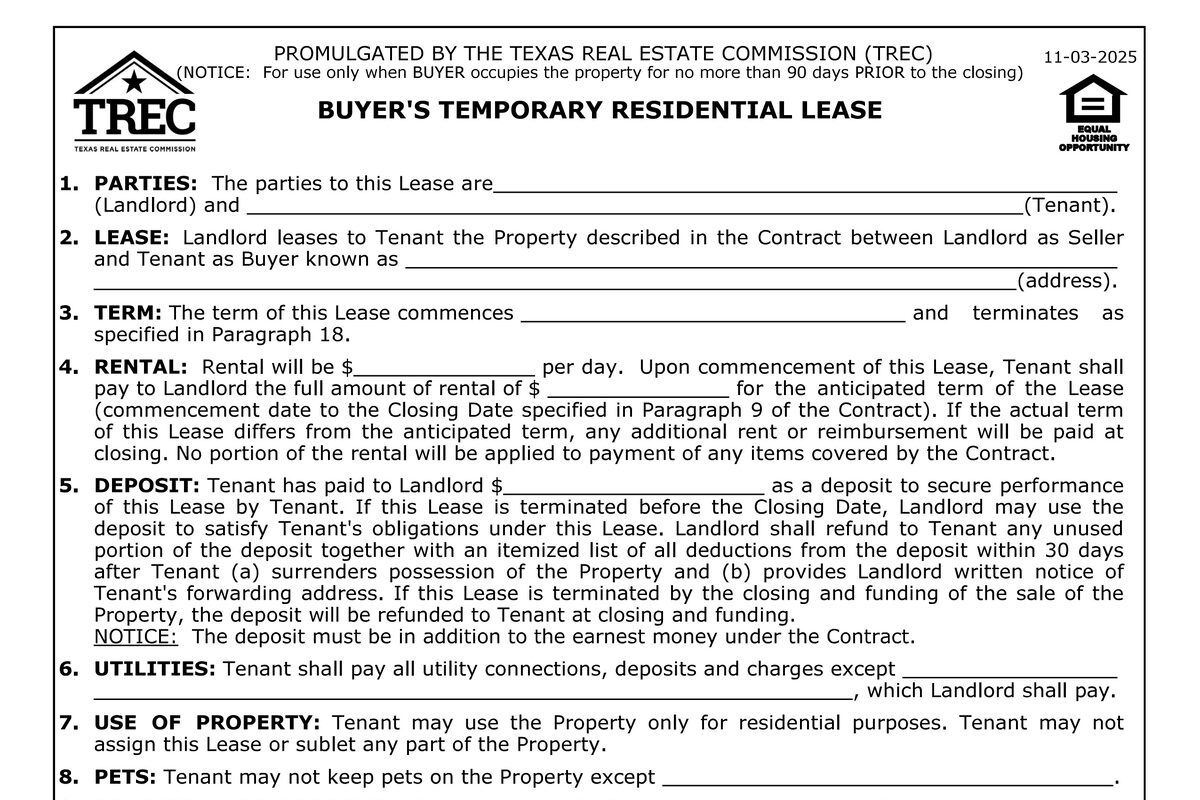
A buyer’s temporary residential lease — TREC Form 16-7 or TXR Form 1911 — allows the buyer to move into your property before the sale closes. It’s one of the most common requests that comes up when closing dates don’t align with move-out dates.
It’s also one of the riskiest things a seller can agree to.
We advise against it in almost every situation. Here’s why, and what to do instead.
Table of Contents
▼What the Form Actually Does
The buyer’s temporary residential lease creates a landlord-tenant relationship between you and the buyer before closing. The buyer pays a daily rental rate, puts down a security deposit, and moves into your house while the sale is still pending.
The lease is supposed to terminate at closing. Possession transfers, the lease ends, and everyone moves on. That’s the plan.
Plans fall apart.
When This Request Comes Up
The buyer’s agent usually brings this up when there’s a timing gap:
- The buyer’s current lease expired and they have nowhere to stay until closing
- The buyer sold their previous home and the closing dates don’t line up
- Closing got delayed — lender issues, title problems, appraisal holdups — and the buyer is stuck
- The buyer is relocating for work and needs to be in the area before the transaction closes
Every one of these is a legitimate reason. None of them eliminate the risk to you as the seller.
Why We Advise Against It
This is the part most articles skip. They explain how the form works. They don’t explain what happens when things go wrong.
If Financing Falls Through, You Have a Tenant
This is the nightmare scenario. The buyer is living in your house. Then their financing collapses — lender denies the loan, the appraisal kills the deal, the buyer’s employment situation changes. Now you have someone occupying your property who can’t buy it.
Under the temporary lease, the buyer is a tenant. If they don’t leave voluntarily, you’re looking at formal eviction proceedings. In Texas, eviction can take 3-6 weeks through the courts — and that’s assuming no complications, no appeals, and no delays. During that time, the buyer is living in your house, you can’t sell to anyone else, and you’re carrying every cost.
That’s months of your life. Not days.
Property Damage Before Closing
Buyers who move in before closing sometimes start making changes. New paint colors. Removed fixtures. Modified landscaping. They feel like it’s their house already — but it isn’t. Not until closing and funding.
If the sale closes, nobody cares about the nail holes. If the sale falls through, you have a property that’s been altered without your consent. Getting compensation for those changes is a separate legal fight, and the security deposit probably won’t cover it.
Insurance Gaps
The form itself warns about this in bold — Paragraph 16 states: “POSSESSION OF THE PROPERTY BY BUYER AS TENANT MAY CHANGE INSURANCE POLICY COVERAGE.” Your homeowner’s insurance policy covers owner-occupied or vacant property. It may not cover a non-owner occupant. The buyer’s renter’s insurance — if they even have it — may not apply because this isn’t a standard rental arrangement.
If someone gets hurt on the property during the temporary lease period, the liability question gets complicated fast. Call your insurance agent before agreeing to anything. Ask specifically whether your policy covers this situation. If it doesn’t, you have a gap — and gaps are where lawsuits live.
The Buyer Starts Finding Problems
Once a buyer is living in a home, they start using it differently than they did during a showing or an inspection. They discover the quirks — the faucet handle you knew to turn a certain way, the outlet that only works if the switch in the hallway is on, the gate latch that sticks. Things you lived with and worked around become problems the buyer wants addressed before they’ll agree to close.
Now you’re negotiating repairs on your own home with someone who’s already living in it. Worse, they may use something the way it wasn’t intended, break it, and expect you to fix it because it “was already like that.” You went from selling your house to defending it.
You Lose All Leverage
Here’s the practical reality: once the buyer is living in your house, they have zero urgency to close quickly. They’re already there. If a problem comes up — lender delay, appraisal issue, title question — the buyer has no incentive to push for a resolution because they’re not sitting in a hotel or sleeping on a friend’s couch.
You, on the other hand, can’t sell to anyone else, can’t move back in, and are watching your carrying costs stack up every day. The leverage shifts entirely to the buyer.
How the TREC Form Works
If you do agree to a temporary lease despite the risks, here’s what the form covers:
Lease period. Start date and end date. The end date is typically tied to the closing date. If closing is delayed, the lease may need to be extended — which requires a separate agreement.
Daily rental rate. Negotiated between the parties. At minimum, it should cover your daily carrying costs — mortgage payment, property taxes, homeowner’s insurance, and HOA fees, prorated to a daily amount. Don’t agree to a token $1/day rate. Charge fair market rent. You’re taking on real risk, and the compensation should reflect that.
Security deposit. Negotiable, but don’t skip it. Per Paragraph 5, the deposit must be added to the earnest money under the contract. A substantial security deposit gives you at least some protection if the buyer damages the property or refuses to vacate. The form provides for refund within 30 days after termination minus an itemized list of deductions.
Utilities. The form addresses who pays for electricity, gas, water, and other services. If the buyer turns utilities on in their name, that’s cleaner. If you keep them in your name, you’re subsidizing someone else’s usage.
Maintenance and liability. Paragraph 14 puts ALL expenses of repairing, replacing, and maintaining the property on the tenant — including the yard, trees, shrubs, and all equipment and appliances. The tenant must promptly repair any damage at their expense. Document the condition before they move in — photos, video, a written walkthrough checklist. If there’s a dispute later, documentation is everything.
Default. Paragraph 17 gives the tenant just 24 hours to cure any failure to perform after notice. That sounds fast on paper. In practice, if they don’t cure, you’re still looking at formal eviction.
Termination. Per Paragraph 18, the lease terminates on: (a) closing and funding, (b) contract termination prior to closing, (c) tenant’s default under the lease, or (d) tenant’s default under the contract — whichever comes first. If they don’t leave, Paragraph 19 creates a tenancy at sufferance with a daily holdover rate — which means you’re collecting a penalty but still going through eviction to get them out.
Our Position
We push back against buyer’s temporary leases in every situation. Even if closing is tomorrow and the buyer just needs one night — the answer is a hotel. The risk is never zero, and there’s always an alternative that doesn’t put the seller in a landlord position on a home they’re trying to sell.
The seller’s temporary residential lease is a different story — sellers sometimes need a few days after closing to move, and that’s a more common and manageable arrangement. But letting a buyer in before they’ve closed and funded? We don’t recommend it.
Better Alternatives
Before agreeing to a temporary lease, push for one of these instead:
The buyer stays in a hotel or short-term rental. It costs money, but it keeps your risk at zero. A few nights at a hotel is cheaper than an eviction.
Shorten the contract timeline. If the buyer needs to be in the home sooner, the answer isn’t early occupancy — it’s a faster closing. Push the buyer to shorten the contract date and lean on their lender to meet it. A motivated lender can move faster than most people think, especially if the buyer has already been through full underwriting upfront.
Negotiate a later closing date. If the timing gap is on the other end — the buyer isn’t ready yet — move the closing date. An amendment to the contract is simpler and safer than a temporary lease.
The buyer arranges a leaseback on their current property. If the buyer sold their home and needs more time, they can negotiate a seller’s temporary residential lease on the property they sold. That keeps the timing problem on the buyer’s side, not yours.
The buyer stores their belongings and stays with family. Not glamorous, but it works. A storage unit and a spare bedroom for a week is a minor inconvenience compared to the risk of a failed closing with an occupant in your house.
The Bottom Line
A buyer’s temporary residential lease before closing is almost never a good idea from the seller’s perspective. You’re accepting landlord liability, insurance risk, potential property damage, and the possibility of a formal eviction — all so the buyer can avoid a few days of inconvenience.
The option period exists to protect the buyer. The earnest money exists to show the buyer is serious. But neither of those protections helps you if someone is already living in your house when the deal falls apart.
If you’re selling your home in Houston and a buyer asks for early occupancy, talk to your broker before agreeing. A full-service listing broker handles these conversations for you and knows when to push back. If you’re managing the sale yourself — as part of a FSBO contract to close — get a real estate attorney’s advice before signing anything.
The safest answer is almost always no.
Related Guides
- Seller’s Temporary Residential Lease in Texas
- Option Period in Texas Real Estate
- Earnest Money vs Option Fee in Texas
- FSBO Contract to Close: What to Expect
- Discount Realtor Houston: Full-Service Listing for 1%
- Third Party Financing Addendum in Texas
- How Much Does It Cost to Sell a House in Houston?
- Sell My Home — Creekstone 1% Listing
Selling a Home in Houston?
1% listing fee. Full service. No long-term contract.
Frequently Asked Questions
What is a buyer's temporary residential lease in Texas?
It's a TREC form (16-7) or TXR form (1911) that allows a buyer to occupy the property before closing. The buyer pays a daily rental rate and takes on responsibility for the property during the lease period. It's essentially a short-term landlord-tenant arrangement layered on top of a pending sale.
Should a seller allow a buyer to move in before closing?
In most cases, no. If the sale falls through, you have an occupant in your home who may need to be formally evicted — a process that can take weeks to months in Texas. The risk to the seller almost always outweighs the convenience to the buyer.
What happens if the buyer moves in and the sale doesn't close?
The buyer becomes a tenant under the temporary lease. If they don't vacate voluntarily when the lease expires, the seller must pursue formal eviction proceedings. In Texas, that process can take 3-6 weeks through the courts — longer if the tenant contests it.
How much should the daily rental rate be on a buyer's temporary lease?
At minimum, it should cover the seller's daily carrying costs — mortgage, property taxes, insurance, and HOA dues prorated to a daily amount. Setting a token amount like $1 per day gives away leverage and doesn't reflect the risk you're taking on.
What are better alternatives to a buyer's temporary residential lease?
The buyer can stay in a hotel or short-term rental, negotiate a later closing date, or arrange a leaseback on their current property. All of these keep the seller's risk at zero while solving the buyer's timing problem.
