

Two Payments, Two Completely Different Jobs
Every residential contract in Texas involves two early payments that confuse nearly everyone the first time through. Both get delivered to the title company within the first few days. Both get credited to the purchase price at closing. But they protect different parties, follow different refund rules, and carry different consequences when a deal falls apart.
The option fee buys the buyer’s right to walk away during the option period. Earnest money proves the buyer is serious about actually closing. Understanding the difference matters — especially if you’re handling offers on your own.
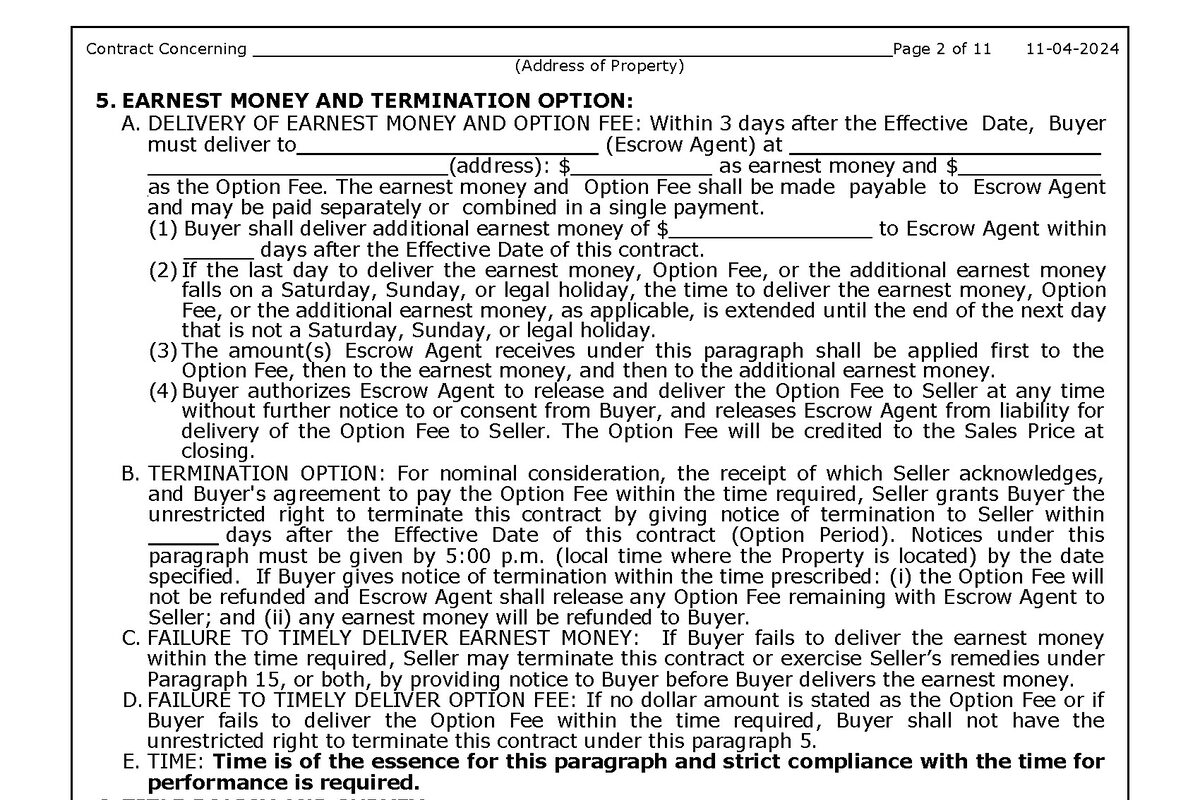
Here’s how each one works under the current TREC 20-18 contract, Paragraph 5.
Table of Contents
▼What the Option Fee Does
The option fee is simple: it buys the buyer an unrestricted right to terminate the contract during the option period. Any reason. No reason. Doesn’t matter. The buyer pays the fee, and in exchange they get a window of time — typically 7-14 days in Houston — to inspect the property, get estimates, sleep on it, or change their mind entirely.
Under Paragraph 5, the option fee is delivered to the escrow agent (the title company) within 3 days of the effective date. The escrow agent then releases it to the seller. It’s non-refundable. The seller keeps it whether the deal closes or not.
If no option fee amount is stated in the contract, or the fee isn’t delivered on time, the buyer has no option period. That’s straight from the contract — no fee, no option. This is a hard deadline. Time is of the essence, and the TREC contract means exactly that.
Typical option fees in the Houston market run $100 to $500 for homes in the $250K-$1M range. The amount is fully negotiable.
If the deal closes, the option fee gets credited to the sales price — so the buyer effectively gets it back as a closing credit.
What Earnest Money Does
Earnest money is the buyer’s good-faith deposit. It tells the seller: I’m serious about this purchase, and I’m putting real money behind that commitment.
Unlike the option fee, earnest money stays in escrow at the title company for the entire transaction. Nobody touches it until closing or until the deal terminates. The title company is a neutral third party — they won’t release earnest money to either side without proper authorization, typically through a signed Release of Earnest Money.
Paragraph 5 requires earnest money to be delivered to the escrow agent within 3 days of the effective date — the same deadline as the option fee. Both can be delivered in a single payment. When they are, the contract specifies the order: the amount applies first to the option fee, then to earnest money, then to any additional earnest money.
In Houston, typical earnest money is about 1% of the purchase price. On a $400,000 home, that’s $4,000. Higher earnest money signals a stronger buyer. Lower earnest money should make a seller ask questions.
Key Differences at a Glance
| Option Fee | Earnest Money | |
|---|---|---|
| Purpose | Buys the right to terminate during option period | Good-faith deposit showing commitment to close |
| Delivered to | Escrow agent, then released to seller | Escrow agent, held in escrow |
| Refundable? | No | Yes, under certain conditions |
| Typical amount (Houston) | $100-$500 | ~1% of purchase price |
| Delivery deadline | Within 3 days of effective date | Within 3 days of effective date |
| At closing | Credited to sales price | Credited to sales price |
| If deal falls apart | Seller keeps it | Depends on how and why |
The 3-Day Delivery Deadline
Both payments are due to the escrow agent within 3 days of the effective date. This is a firm deadline. The weekend/holiday extension rule applies — if the deadline falls on a Saturday, Sunday, or legal holiday, it extends to the next business day. But don’t rely on that as a strategy. Deliver both on day one if possible.
Here’s where it gets serious: if the buyer fails to deliver earnest money on time, the seller may have remedies under the contract — but they’re not automatic and the specifics depend on the contract language. The seller must act before the buyer delivers the earnest money. If the buyer gets the money to the title company before the seller acts, that window closes.
This is one of those situations where hours matter. If you’re a seller and the earnest money hasn’t shown up by day 3, don’t wait until day 5 to do something about it. Talk to your broker or attorney immediately.
What Happens When a Deal Falls Apart
During the Option Period
The buyer terminates. The seller keeps the option fee — that was the price of the buyer’s right to walk away. Earnest money gets refunded to the buyer. Both parties sign the Release of Earnest Money, and the title company sends the deposit back. This is the cleanest exit scenario.
After the Option Period — Financing Falls Through
If the buyer’s loan gets denied and they followed the timeline in the Third Party Financing Addendum, earnest money is typically refunded. The buyer provides the lender’s denial letter, both parties sign the release, and title refunds the money. The option fee was already released to the seller earlier in the process.
After the Option Period — Buyer Defaults
This is where disputes happen. The buyer decides they don’t want the house but has no contractual right to terminate. The seller believes the earnest money is theirs. The buyer disagrees. The title company won’t release funds without both signatures on the Release of Earnest Money — or a court order.
Earnest money disputes can drag on for months. This is one reason higher earnest money matters to sellers — it gives the buyer a real financial reason to follow through.
Strategy for Sellers: What the Numbers Tell You
As a listing broker, here’s what I look at when reviewing an offer.
A higher option fee means the buyer has more skin in the game during inspections. A $100 option fee on a $500,000 home tells me the buyer isn’t that worried about losing $100 if they walk. A $500 option fee on the same home is a different signal — not dramatically different, but it adds up with everything else in the offer.
Higher earnest money tells me the buyer is committed to closing. A buyer putting down $5,000 on a $500,000 home has real money at risk after the option period expires. A buyer putting down $500 on that same home can walk away after the option period and barely feel it — which means the seller is the one left holding the bag while they relist.
Two offers can be at the same price and have completely different risk profiles based on the option fee and earnest money amounts. If you’re selling FSBO and reviewing offers yourself, don’t just look at the purchase price. Look at what the buyer is willing to put at risk.
What Happens If the Option Fee Is Missing
This trips up more people than you’d expect. Under Paragraph 5, if no option fee amount is stated in the contract or the fee is not timely delivered, the buyer does not have an option period. Period.
That means the buyer has no unrestricted right to terminate. From the moment the contract is executed, they’re bound by the terms — and the only exits available are the ones built into the contract (financing contingency, title objections, etc.).
If you’re a buyer, make sure the option fee is clearly stated and delivered on time. If you’re a seller and the buyer’s contract doesn’t include an option fee, understand what that means: the buyer is locked in tighter, but they also have more reason to fight over earnest money if something goes wrong during inspections.
The Honest Take
Both payments exist to balance risk. The option fee gives the buyer flexibility to walk away early — but the seller gets paid for that flexibility. Earnest money gives the seller confidence the buyer will close — and gives the buyer a financial reason to follow through.
Neither one is complicated on its own. The problems start when people confuse the two, miss a deadline, or assume they know the refund rules without reading the contract. If you’re navigating a Texas real estate transaction — whether you’re managing the process yourself or working with a discount realtor in Houston — knowing how these two payments work puts you ahead of most buyers and sellers at the table.
Related Guides
- Option Period in Texas Real Estate
- Release of Earnest Money in Texas
- FSBO Contract to Close: What to Expect
- How to Handle Offers When Selling FSBO
- Third Party Financing Addendum in Texas
- Discount Realtor Houston: Full-Service Listing for 1%
- Sell My Home — Creekstone 1% Listing
Selling a Home in Houston?
1% listing fee. Full service. No long-term contract.
Frequently Asked Questions
What is the difference between earnest money and an option fee in Texas?
The option fee buys the buyer's right to terminate during the option period. It's non-refundable and released directly to the seller. Earnest money is a good-faith deposit held in escrow by the title company, refundable if the buyer terminates during the option period or under other valid contract provisions.
Is the option fee refundable in Texas?
No. Under TREC 20-18 Paragraph 5, the option fee is non-refundable once delivered. It's released to the seller regardless of whether the deal closes. If the deal does close, the option fee is credited to the sales price.
How much earnest money is typical in Houston?
About 1% of the purchase price. On a $400,000 home, expect around $4,000. The amount is negotiable, and higher earnest money signals a more committed buyer.
What happens to earnest money if the buyer backs out after the option period?
It depends on why. If the buyer terminates under a valid contract provision — like financing denial under the Third Party Financing Addendum — earnest money is refundable. If the buyer walks without a contractual right, the seller may be entitled to keep it as damages.
Can the option fee and earnest money be paid together?
Yes. Under Paragraph 5 of the TREC contract, the buyer can deliver both in a single payment to the escrow agent. The amount is applied first to the option fee, then to earnest money, then to any additional earnest money.
