

That Equipment on Your Roof Might Not Be Yours
You installed solar panels three years ago. Or maybe the previous owner did. Either way, they’re bolted to the roof, wired into the electrical panel, and producing electricity. They look like they belong to the house.
But if they’re leased, they don’t. And when you sell, that distinction matters — a lot.
Fixture leases cover equipment that’s physically attached to the property but owned by a third-party leasing company. Solar panels are the most common, but the same applies to water softeners, propane tanks, security systems, and water purification equipment. The hardware stays with the house. The lease obligation transfers to the buyer.
If you don’t disclose it properly, you’re creating a problem that follows the transaction well past closing.
Table of Contents
▼What Counts as a Leased Fixture
A fixture is anything attached to the property that would normally convey with the sale — think of it as equipment that’s bolted, wired, or plumbed in. If removing it would leave holes in the roof, gaps in the plumbing, or disconnected wiring, it’s a fixture.
Common leased fixtures in the Houston market:
- Solar panels — by far the most common, with lease terms running 20-25 years
- Water softeners — typically month-to-month or short-term leases
- Propane tanks — common in rural areas outside city gas service
- Security and alarm systems — often leased with monitoring contracts
- Water purification systems — whole-house filtration or reverse osmosis units
The key distinction: if you own the equipment outright, it conveys with the property like any other fixture. If it’s leased, the buyer inherits the lease — and they need to know about it before they sign the contract.
The TREC Contract and Paragraph 4B
The TREC 1-4 residential contract addresses fixture leases directly in Paragraph 4B. This paragraph requires sellers to identify any leased items that are attached to the property and won’t be owned by the buyer at closing.
This isn’t optional language. If leased fixtures exist, they must be disclosed in the contract.
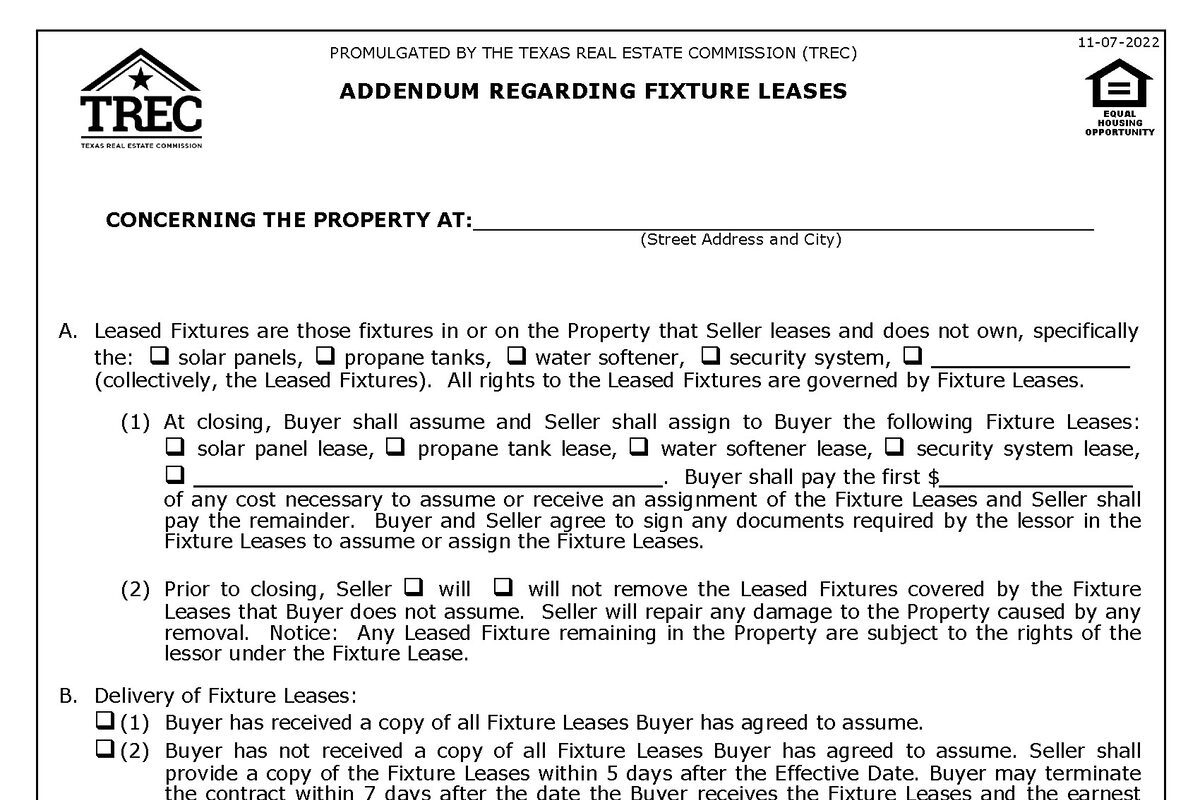
TREC also created a dedicated form for this — the Addendum Regarding Fixture Leases (TREC Form 52-1). This addendum gets attached to the contract and spells out:
- What equipment is leased
- The name of the leasing company
- The lease terms (monthly payment, remaining term, total remaining balance)
- Whether there’s a buyout option and what it costs
- Transfer requirements — what the leasing company needs from the buyer
The addendum exists because a one-line mention in the contract isn’t enough. Buyers need the full picture before they commit.
Solar Panels — The Big One
Solar leases are the fixture lease issue you’ll encounter most often, and they’re the one that creates the most friction in transactions.
Here’s why. A typical residential solar lease in Texas runs 20-25 years. Monthly payments range from $100-$300 depending on system size. If the homeowner is five years into a 25-year lease, the buyer is inheriting 20 years of payments and potentially $25,000-$40,000 in remaining obligations.
That’s not a minor detail. That’s a second mortgage-sized commitment that the buyer didn’t ask for.
Some additional complications with solar leases:
- Lender scrutiny. Some mortgage lenders factor the solar lease payment into the buyer’s debt-to-income ratio. A $200/month lease payment reduces the buyer’s purchasing power by roughly $35,000-$40,000 in loan amount.
- Roof maintenance. If the roof needs replacement during the lease term, the homeowner typically pays to have the panels removed and reinstalled — a cost that can run $3,000-$8,000 on top of the roof replacement.
- Transfer approval. The leasing company must approve the transfer to the new buyer. This adds a step and a timeline to your closing process.
- Buyer resistance. A meaningful percentage of buyers will simply move on when they learn about a solar lease. It’s not about the panels — it’s about the long-term financial obligation they didn’t budget for.
If you’re listing a home with a solar lease, know the exact terms before your first showing. Monthly cost, remaining term, total remaining balance, buyout option, and transfer process. Have this information ready — don’t make the buyer’s agent chase it down.
Sell your home for just 1% commission.
What Sellers Need to Disclose
Beyond filling out the TREC 52-1 addendum, sellers must disclose fixture leases on the seller’s disclosure notice. Here’s what you need to have ready:
- The lease agreement itself. The buyer and their attorney or agent will want to review the actual contract — not your summary of it.
- Monthly payment amount. What the buyer will be paying each month after closing.
- Remaining term. How many months or years are left on the lease.
- Total remaining balance. The full amount of payments left on the lease.
- Buyout option. Whether the lease can be paid off early and at what cost. Some leases have declining buyout schedules. Some don’t allow early termination at all.
- Transfer requirements. What the leasing company requires to transfer the lease — credit check, application, approval timeline.
Don’t wait until the buyer asks for this information. Have it organized and ready to present at the time of listing. Surprises during the option period kill deals.
Practical Advice for Sellers
Know your lease terms before you list. Call the leasing company and get current figures in writing — the remaining balance, monthly payment, buyout amount, and transfer process. These numbers change over time, and the figures you remember from when you signed may not be accurate.
Consider the buyout. If the buyout amount is manageable, paying off the lease before listing simplifies your transaction and removes a buyer objection. Run the math: if the buyout is $8,000 and the lease is scaring off buyers, the buyout pays for itself.
Price accordingly. A home with a solar lease and 18 years remaining is a different product than the same home without one. Understand that some buyers will factor the remaining lease obligation into their offer — and they’re not wrong to do so.
Don’t hide it. Failing to disclose a fixture lease doesn’t make it go away. The buyer will find out — during inspections, during title work, or when the leasing company contacts them. Concealing a material fact is a legal liability you don’t want.
If managing this process feels like a lot — it is. A discount realtor in Houston can handle the disclosure requirements, negotiate the lease transfer, and make sure the TREC paperwork is done right, without the traditional 6% commission.
Advice for Buyers
If you’re buying a home with leased fixtures, treat the lease review like you’d treat any other financial obligation you’re taking on.
- Read the full lease agreement, not just the seller’s summary
- Confirm the monthly payment, remaining term, and buyout terms directly with the leasing company
- Ask your lender whether the lease payment affects your qualification
- Factor the lease payments into your total monthly housing cost — not just the mortgage
- Understand the roof implications if solar panels are involved
Don’t assume the lease is a good deal just because the seller says it saves on electricity. Do your own math.
Sell your home for just 1% commission.
The Bottom Line
Fixture leases are a disclosure issue, a negotiation issue, and sometimes a deal-breaker. Solar panels are the most common and the most consequential, but any leased equipment attached to the property needs to be disclosed and documented.
If you’re selling, get ahead of it. Know your lease terms, complete the TREC 52-1 addendum, and present the information upfront. If you’re selling FSBO, make sure you understand the addendum requirements — this is one of those areas where missing a form can create real problems after closing.
If you’re not sure whether your equipment is leased or owned, check. Pull your records, call the company, and find out before you list. It’s a 15-minute phone call that can save you weeks of negotiation headaches during the contract-to-close process.
Related Guides
Frequently Asked Questions
What is a fixture lease in Texas real estate?
A fixture lease is a lease agreement on equipment that's physically attached to or installed in the property — solar panels, water softeners, propane tanks, security systems. The equipment stays with the house, but the homeowner doesn't own it. The lease obligation transfers to the buyer at closing.
Do I have to disclose a solar panel lease when selling my house in Texas?
Yes. The TREC 1-4 contract (Paragraph 4B) specifically addresses fixture leases. Sellers must disclose any leased fixtures, and the TREC Addendum Regarding Fixture Leases (Form 52-1) must be attached to the contract with the lease terms, monthly cost, remaining balance, and transfer requirements.
Can a buyer refuse to buy a house with a solar lease?
Absolutely. Some buyers won't consider a property with an active solar lease, especially if the remaining balance is high or the monthly payment is steep. A 20-year solar lease with $30,000+ remaining is a deal-breaker for a significant number of buyers.
Can I buy out my solar lease before selling?
Most solar leases include a buyout option, though the cost depends on the remaining term and the lease agreement. If the buyout is reasonable, paying it off before listing removes a potential objection and widens your buyer pool. Get the buyout amount in writing from the leasing company before you decide.
What happens to a fixture lease if I sell my house?
The lease transfers to the buyer at closing — they take over the payments and the remaining term. The buyer must qualify with the leasing company, and some lenders factor the lease payment into the buyer's debt-to-income ratio, which can affect their financing.
