

If Your Property Has an HOA, This Addendum Matters
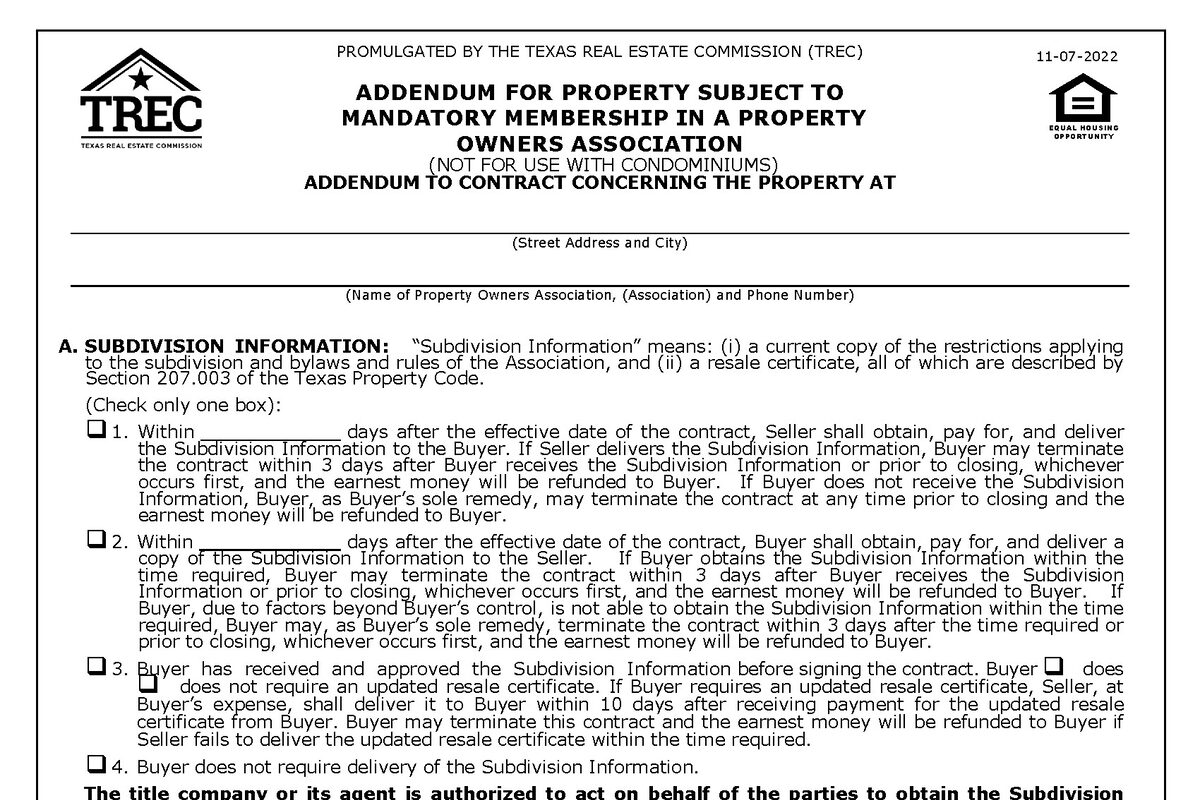
Every property in Texas with a mandatory homeowners association or property owners association requires a specific addendum attached to the contract: TREC Form 36-10, the Addendum for Property Subject to Mandatory Membership in a Property Owners Association.
It’s not optional. If your neighborhood has an HOA, this form is part of the deal — and the resale certificate it triggers is one of the documents that can delay or kill a closing if you’re not prepared for it.
Here’s what the addendum requires, what the resale certificate contains, and what you should do before you ever list.
Table of Contents
▼What the TREC 36-10 Addendum Does
The addendum establishes the framework for how HOA-related information gets handled during the transaction. It covers:
- Who orders the resale certificate — usually the title company, though the contract can assign this to the seller or buyer.
- Who pays for it — negotiable, but typically the seller. Expect $200-400 depending on your management company. Some charge more for rush delivery.
- The buyer’s review period — the buyer gets a defined number of days to review the resale certificate and all HOA governing documents. If they don’t like what they see, they can object.
- What happens if there’s a dispute — if the buyer objects and the seller can’t cure the issue, the buyer can terminate and recover their earnest money.
This is one of those forms that looks routine until something goes wrong. Read every blank before you sign it.
What’s in the Resale Certificate
The resale certificate is a snapshot of the property’s standing with the HOA. Under Texas Property Code §207.003, the association must provide this document within 10 business days of the request. It includes:
- Current dues and assessment amounts — monthly or annual, plus any special assessments that have been levied or are pending.
- Outstanding balances — any unpaid dues, fines, or fees tied to the property. These become a lien that the title company must clear before closing.
- Violations — open or unresolved violations against the property. Fence issues, unapproved modifications, landscaping complaints, parking violations.
- Reserve fund balance — how much money the HOA has in reserves. A low reserve fund can signal future special assessments, which concerns buyers.
- Pending litigation — any lawsuits involving the HOA. Buyers and their lenders pay attention to this — it can affect financing approval.
- Insurance coverage — the association’s master insurance policy details.
- Governing documents — bylaws, CC&Rs, rules and regulations, architectural guidelines.
The buyer reviews all of this. If they see something they don’t like — a $5,000 special assessment that hasn’t been billed yet, a pending lawsuit, rules that prohibit something important to them — they have the right to object within the timeframe defined in the addendum.
Transfer Fees and Other Surprises
Beyond the resale certificate fee, many HOAs charge a transfer fee when the property changes hands. This is separate from the resale certificate cost and can run $100-500 or more. Some associations also charge document preparation fees, capital contribution fees, or move-in/move-out fees.
These fees are typically disclosed in the resale certificate, but if you want to avoid surprises at closing, call your HOA or management company before you list. Ask for a complete list of fees associated with a sale. Get it in writing.
The fees are negotiable between buyer and seller in the contract. Know what they are before you’re sitting at the negotiation table.
Sell your home for just 1% commission.
What Delays Closings — and How to Avoid It
Most HOA-related closing delays come from three sources:
Unpaid dues or fines. The title company won’t close until the seller’s account is current. If you owe $1,200 in back dues and fines, that balance has to be paid or escrowed before funding. Check your account status before listing and bring everything current.
Unresolved violations. A violation letter you ignored six months ago doesn’t disappear when you go under contract. It shows up on the resale certificate, the buyer’s agent flags it, and now you’re scrambling to fix a fence or remove an unapproved structure while the clock ticks toward closing. Resolve violations before listing — it’s always easier and cheaper to handle them on your timeline than on a contract deadline.
Late resale certificate delivery. The HOA has 10 business days to deliver the certificate. Some management companies treat that as a suggestion. If the certificate arrives late, the buyer’s review period shifts, which can push closing. The title company typically orders the certificate shortly after receiving the contract — but follow up. Don’t assume it’s been requested or received.
Practical Advice: What to Do Before You List
If your property is in an HOA, here’s your pre-listing checklist:
- Call your HOA or management company. Ask for your current account status — dues, fines, violations, everything. Get it in writing.
- Ask about all transfer-related fees. Resale certificate fee, transfer fee, capital contribution, document fees. Write them down.
- Resolve every open violation. If you have an unapproved shed, a fence that doesn’t meet guidelines, or a landscaping complaint — fix it now. Not next week. Now.
- Request a pre-listing status letter if your management company offers one. Some do, some don’t. It’s not the same as the resale certificate, but it gives you a heads-up on what the certificate will show.
- Budget for HOA-related closing costs. Between the resale certificate, transfer fees, and any outstanding balances, HOA costs at closing can add up to $500-1,000 or more. Factor this into your net proceeds estimate.
How This Connects to Your Other Disclosures
The HOA addendum doesn’t exist in a vacuum. It’s one piece of a larger disclosure obligation you have as a Texas seller. If your property is also in a MUD or other special district, you’ll need the MUD disclosure as well. Properties in a PID require a separate PID disclosure. These stack — a property can be in an HOA, a MUD, and a PID simultaneously, and each one has its own required addendum and disclosure.
If you’re managing the contract-to-close process yourself, keeping track of which disclosures are required and when they’re due is critical. Miss one and you’ve given the buyer a reason to delay or terminate.
Sell your home for just 1% commission.
The Bottom Line
The HOA resale certificate is not a formality. It’s a document that can surface financial obligations, legal issues, and rule violations that directly affect whether your deal closes on time — or closes at all.
Call your HOA before you list. Know your fees. Clear your violations. And read the TREC 36-10 addendum before you sign it, because the blanks in that form determine who pays for what and how long the buyer has to back out.
If you’d rather have someone manage this process for you, that’s what we do. Creekstone lists homes for 1% commission — full service, every form handled, every deadline tracked.
Related Guides
Frequently Asked Questions
Who pays for the HOA resale certificate in Texas?
It's negotiable. In the Houston market, the seller typically pays for the resale certificate as part of closing costs. The cost runs $200-400 depending on the management company. The TREC addendum (36-10) specifies who is responsible — read it before you sign.
How long does it take to get a resale certificate from the HOA?
Texas Property Code §207.003 requires the HOA to deliver the resale certificate within 10 business days of the request. Some management companies are faster. Some wait until the last day. Plan accordingly — order it early.
What happens if I have HOA violations when I sell?
Unresolved violations show up on the resale certificate. They can delay closing because the title company may hold funds in escrow or require the violation to be cured before funding. Fix violations before you list — it's cheaper and less stressful than dealing with them mid-transaction.
Can a buyer back out because of HOA issues?
Yes. Under the TREC addendum, the buyer has a set number of days to review the resale certificate and HOA documents. If they object to something — high dues, pending assessments, restrictive rules — and you can't resolve it, the buyer can terminate and get their earnest money back.
What is TREC Form 36-10?
It's the Addendum for Property Subject to Mandatory Membership in a Property Owners Association. It's required any time the property is in an HOA or POA. The form addresses who orders the resale certificate, who pays for it, the buyer's review period, and what happens if the association's documents reveal issues.
