

A Federal Requirement That Catches Sellers Off Guard
If your home was built before 1978, there’s a federal disclosure you’re required to provide to the buyer before they sign a contract. Not a Texas requirement — a federal one. It’s called the lead-based paint disclosure, and it’s governed by the Residential Lead-Based Paint Hazard Reduction Act and enforced by the EPA.
This comes up constantly with seller disclosures in Texas. Sellers know about the standard TREC Seller’s Disclosure Notice. They know about the HOA addendum. But the lead-based paint disclosure? It gets missed — especially by FSBO sellers who don’t have an agent walking them through the paperwork stack.
Here’s everything you need to know so you don’t skip it.
Table of Contents
▼What the Law Requires
The lead-based paint disclosure has three components. All three are mandatory.
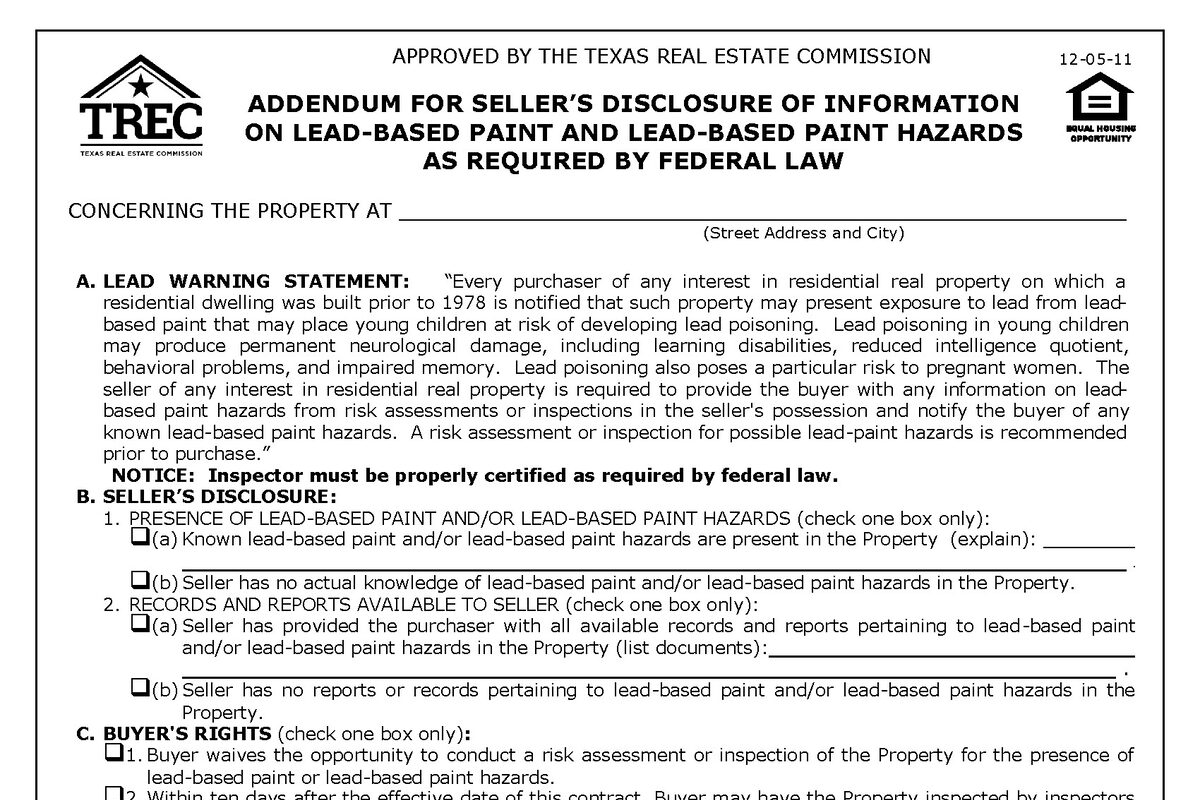
1. Disclose what you know. If you have any knowledge of lead-based paint or lead-based paint hazards in the home, you must tell the buyer. If previous testing was done, you must provide the buyer with a copy of the results. If you don’t know of any lead paint — which is the case for most sellers — you check the box that says so. Either way, the form gets filled out.
2. Provide the EPA pamphlet. You must give the buyer a copy of the EPA’s pamphlet titled Protect Your Family From Lead in Your Home. It’s a free download from the EPA’s website. Your agent or title company should have copies. If you’re selling FSBO, download it and print it yourself.
3. Give the buyer 10 days to inspect. The buyer has the right to conduct a lead-based paint inspection or risk assessment at their own expense during a 10-day period. This is separate from the standard option period. The buyer can waive this right — and most do — but you must offer it.
The form used in Texas is the TREC OP-L, which satisfies both the federal EPA requirement and the Texas Real Estate Commission’s requirements. Both the seller and buyer sign it.
When It Applies — and When It Doesn’t
The rule is simple: if the home was built before 1978, the disclosure is required. The government banned lead-based paint for residential use in 1978, so any home built before that date could contain it.
There are a few narrow exemptions:
- Housing for the elderly or disabled (unless children under 6 are expected to reside there)
- Zero-bedroom dwellings (studios, dormitories, etc.)
- Foreclosure sales
- Leases of 100 days or less
If none of those apply — and for most residential sales, none of them do — the disclosure is required.
Sell your home for just 1% commission.
What Sellers Commonly Get Wrong
Assuming “I don’t know about any lead paint” means you can skip the form. It doesn’t. Even if you have zero knowledge of lead paint, you still fill out the form and check the box that says you have no knowledge. The form documents both the disclosure and the buyer’s receipt of the EPA pamphlet.
Not providing it before the contract is signed. The disclosure must be provided before the buyer is obligated under a contract. In practice, this means it should be part of the initial paperwork package — not something you hand over at closing.
Forgetting about it entirely during a FSBO sale. When you’re managing the contract-to-close process yourself, it’s easy to miss forms that aren’t part of the standard TREC contract package. The lead-based paint disclosure is a separate document, and nobody is going to remind you about it if you don’t have an agent.
Thinking it only matters if the paint is chipping or peeling. The disclosure requirement applies regardless of the paint’s condition. A pre-1978 home with perfectly maintained original paint still requires the disclosure.
Penalties for Non-Disclosure
This is where it gets serious. The EPA doesn’t treat lead-based paint violations as paperwork technicalities.
- Civil penalties up to $19,507 per violation
- Criminal penalties for knowing and willful violations
- Treble damages in private lawsuits — the buyer can sue for three times their actual damages plus attorney’s fees
- Voiding the contract — the buyer may have grounds to rescind the sale entirely
These aren’t theoretical. The EPA actively enforces lead-based paint disclosure requirements. Individual sellers have been fined, and real estate companies have paid six-figure settlements. This is not a form you want to skip.
The Practical Advice
If your home was built before 1978, just do it. Fill out the TREC OP-L, hand the buyer the EPA pamphlet, and offer them 10 days to inspect. The whole process takes 15 minutes and costs nothing.
You don’t have to test for lead paint. You don’t have to remediate anything. You just have to tell the buyer what you know (even if the answer is “nothing”) and give them the opportunity to investigate for themselves.
If you’re working with a discount realtor in Houston, they’ll handle this as part of the listing paperwork. If you’re selling FSBO, download the TREC OP-L form and the EPA pamphlet, and make them part of your disclosure package alongside the standard seller’s disclosure.
The cost of compliance is zero. The cost of non-compliance starts at $19,507 and goes up from there. This one isn’t even a close call.
Sell your home for just 1% commission.
Related Guides
Frequently Asked Questions
Do I have to disclose lead-based paint if my home was built before 1978?
Yes. Federal law — the Residential Lead-Based Paint Hazard Reduction Act of 1992 — requires sellers of homes built before 1978 to disclose known lead-based paint and lead-based paint hazards. This is not optional and applies in every state, including Texas.
What happens if I don't provide the lead-based paint disclosure?
Penalties are steep. The EPA can impose fines up to $19,507 per violation (adjusted for inflation). Sellers can also face treble damages in private lawsuits — meaning a court can award the buyer three times their actual damages, plus attorney's fees.
Does the seller have to test for lead paint before selling?
No. The law does not require you to test for lead paint. You only have to disclose what you know. If you've never had the home tested, you check the box that says you have no knowledge of lead-based paint. But if you do know — because a previous test came back positive or you can see deteriorating paint that's clearly old — you must disclose it.
Can the buyer waive the 10-day inspection period?
Yes. The buyer can waive their right to a lead-based paint inspection, and many do. But the seller must still offer the opportunity. The waiver is documented on the disclosure form itself — the buyer initials the waiver section.
Does the lead-based paint disclosure apply to condos and townhomes?
Yes, if the unit was built before 1978. The disclosure requirement applies to all residential housing — single-family homes, condos, townhomes, duplexes, and multi-family properties. The only exemptions are housing for the elderly (unless children are present), zero-bedroom units, and properties being sold at foreclosure.
