

If You’re in a MUD, You Have a Disclosure Obligation
If your property is inside a Municipal Utility District, Texas law requires you to give the buyer a written notice before the sale closes. Skip it, and you’re handing the buyer a reason to come after you later.
In Houston’s suburbs — Katy, Cypress, Sugar Land, Pearland, and most of the master-planned communities along the Grand Parkway — MUDs are everywhere. They’re not unusual. They’re not a problem. But they do come with a specific disclosure requirement that a surprising number of sellers don’t know about.
Table of Contents
▼What Is a MUD?
A Municipal Utility District is a political subdivision of the state of Texas. MUDs are created to finance and manage water, sewer, drainage, and road infrastructure in areas that aren’t served by a city’s municipal system. The developer creates the MUD, the MUD issues bonds to pay for infrastructure, and homeowners repay those bonds through property taxes levied by the district.
If you live in a newer Houston-area subdivision outside city limits, there’s a good chance your water and sewer service comes from a MUD — not the city.
MUDs are governed by a board of directors, operate under the oversight of the Texas Commission on Environmental Quality (TCEQ), and have the authority to levy property taxes, issue bonds, and charge standby fees.
Why Texas Requires MUD Disclosure
Texas Water Code Chapter 49 requires sellers of property within a MUD to provide buyers with written notice of the district. The logic is straightforward: MUD taxes are an additional tax obligation beyond what the buyer might expect, and the buyer needs to know about it before they commit to the purchase.
MUD tax rates vary widely — some are modest, others add a meaningful amount to the annual tax bill. If the district still has outstanding bond debt, the buyer inherits that obligation. The state decided buyers deserve to know this upfront, not after closing.
What Must Be Disclosed
The MUD notice must include:
- Tax rate — the current MUD tax rate per $100 of assessed valuation
- Bonded indebtedness — the total outstanding bond debt of the district
- Standby fees — any fees the MUD charges to property owners for the availability of water and sewer service, even if those services aren’t currently being used
- The district’s right to levy taxes and issue bonds — a general statement that the MUD has taxing authority
- A statement that the property is within the district — seems obvious, but it’s a required element
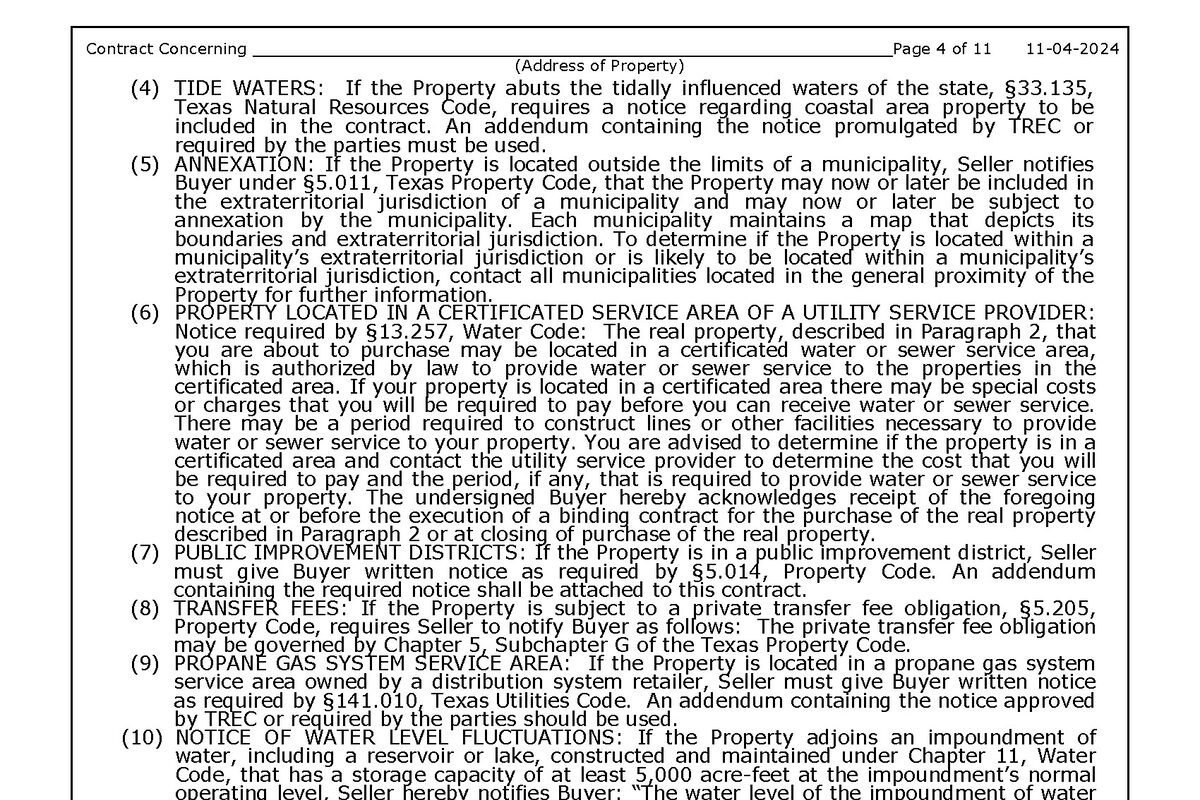
The TREC promulgated contract includes an addendum (MUD, Water District, or Other District addendum) that addresses this. If you’re using the standard TREC contract, make sure this addendum is completed and attached.
How to Find Your MUD Information
Start with the TCEQ Water District Database. You can search by district name, county, or location. This gives you the district’s ID number, creation date, bond information, and contact details.
For current tax rates, check your county appraisal district:
- Harris County Appraisal District (HCAD)
- Fort Bend Central Appraisal District
- Brazoria County Appraisal District
- Galveston Central Appraisal District
Enter your property address, and the appraisal district will show every taxing entity — including the MUD — along with its current tax rate.
Your most recent property tax bill also works. Look for a line item that references a water district, MUD, or utility district. The tax rate and amount are right there.
What Happens If You Don’t Disclose
If you fail to provide the required MUD notice, the buyer can terminate the contract. Under Texas Water Code § 49.452, the buyer has the right to rescind the contract and recover earnest money if the notice wasn’t provided.
Even after closing, failure to disclose can expose you to liability. If the buyer discovers they’re in a MUD with a significant tax rate and you never told them, that’s a potential claim against you — especially if they can show you knew and didn’t disclose.
This isn’t theoretical. It happens. And it’s entirely preventable by filling out a one-page form.
Practical Advice for Houston Sellers
Don’t panic about being in a MUD. Buyers in the Houston suburbs expect MUD taxes. Almost every newer subdivision has one. The buyer’s lender will account for the MUD tax rate when qualifying the buyer. It’s not a deal-killer — it’s a line item. The issue isn’t being in a MUD. The issue is not disclosing it.
If you’re selling FSBO, don’t skip this. The contract-to-close process has enough moving parts without adding a disclosure deficiency to the list. Download the addendum from TREC’s website, fill it out, and include it with your disclosure packet. It takes ten minutes.
If your property is also in a PID, you need a separate disclosure. Some Houston-area properties are in both a MUD and a Public Improvement District. These are different districts with different disclosure requirements. Don’t assume one covers the other.
Include it early. Attach the MUD notice to your seller’s disclosure package from the start. Don’t wait for the buyer to ask. Getting it out of the way early prevents it from becoming a negotiation issue later.
The Bottom Line
MUD disclosure in Texas is a legal requirement, not a suggestion. If your property is in a MUD — and in the Houston suburbs, it probably is — fill out the notice and deliver it to the buyer before or at the time the contract is executed. It’s a simple form that takes minutes to complete. Skipping it creates risk that doesn’t need to exist.
Related Guides
Selling a Home in Houston?
1% listing fee. Full service. No long-term contract.
Frequently Asked Questions
How do I know if my property is in a MUD?
Search the TCEQ Water District Database at tceq.texas.gov. You can also check your property tax bill — if you see a line item for a water district or MUD, your property is in one. Your county appraisal district website will also show the taxing entities for your address.
Who is responsible for providing the MUD disclosure — the seller or the agent?
The seller is legally responsible. If you're working with a listing agent, they should prepare the notice and ensure it's delivered, but the obligation is on the seller. If you're selling FSBO, this is on you.
When does the MUD disclosure need to be given to the buyer?
The notice must be provided at or before the contract is executed. In practice, most agents include it in the disclosure packet at the time the property is listed or when the buyer submits an offer.
Is a MUD disclosure the same as the seller's disclosure?
No. The MUD notice is a separate, specific document required under Texas Water Code Chapter 49. It covers the district's tax rate, bonded indebtedness, and standby fees. The seller's disclosure (TREC form) covers the physical condition of the property. You need both.
What happens if my property is in a MUD and a PID?
You need separate disclosures for each. MUD disclosure is required under Texas Water Code Chapter 49. PID disclosure is required under Texas Local Government Code Chapter 372. They cover different things and neither one substitutes for the other.
