

The Buyer’s Exit Window — and the Seller’s Most Uncertain Days
You accepted an offer. The contract is signed. And now you wait while the buyer decides whether they actually want your house.
That’s the option period. It’s a defined number of days where the buyer can walk away for any reason — bad inspection, cold feet, better house down the street, didn’t like the neighbor’s dog. Doesn’t matter. During the option period, they have the unrestricted right to terminate.
For sellers, this is the most nerve-wracking stretch of the transaction. Your home is off the market, but it’s not sold. Here’s how it works under the TREC 20-18 contract and what you need to watch for.
Table of Contents
▼How the Option Period Works Under TREC 20-18
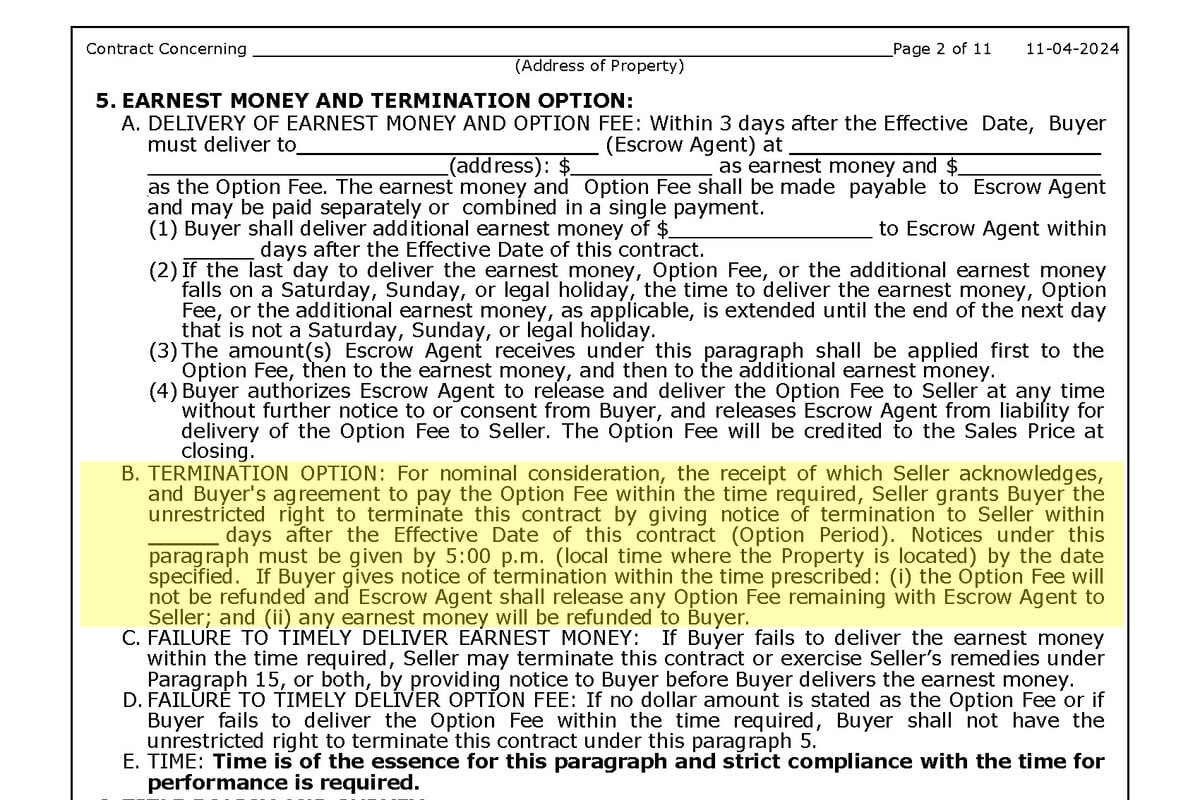
The option period lives in Paragraph 5B of the standard Texas residential contract. Here’s what it actually says, in plain language:
The buyer pays a non-refundable option fee. Both the option fee and earnest money must be delivered to the escrow agent (usually the title company) within 3 days of the effective date. The option fee is credited toward the purchase price at closing — so the buyer gets it back as a line-item credit if the deal closes.
The option period gives the buyer an unrestricted right to terminate. During the agreed-upon number of days, the buyer can terminate for any reason by giving written notice to the seller. That’s it. No explanation required. No negotiation necessary.
If no option fee is stated or the buyer doesn’t deliver it, there is no option period. This is straight from the contract. If no dollar amount is written in as the option fee, or the buyer fails to deliver it within the deadline, the buyer does not have the unrestricted right to terminate. This is a detail FSBO sellers miss constantly — more on that below.
Time is of the essence. The contract uses this exact phrase. It means deadlines are strict. Not guidelines. Not suggestions. Strict.
The 5:00 PM Deadline
Termination notice must be delivered by 5:00 PM local time where the property is located on the last day of the option period. If the property is in Houston, the deadline is 5:00 PM Central — not wherever the buyer happens to be. The contract says time is of the essence — deadlines are strict. If the option period ends on a Saturday, it ends on Saturday. There’s no business day extension for the termination deadline itself.
Buyers: don’t wait until the last day to make your decision. Email servers go down. Google has outages. If something goes wrong with electronic delivery, you may need to get paperwork signed and physically hand-deliver it to the listing agent or their broker’s office — and in a city the size of Houston, that can take hours. Once the option period expires, getting out of the contract gets expensive. Give yourself a cushion.
As a seller, mark the exact date and time on your calendar. If 5:01 PM passes with no termination notice, the buyer just lost their unrestricted exit.
What Happens During the Option Period
The option period is the buyer’s due diligence window. Here’s what’s typically happening:
Inspections. The buyer schedules a home inspection and you provide access. If the inspector flags specific concerns — or the seller’s disclosure indicates issues — the buyer may bring in specialists like a foundation engineer, roof inspector, pool inspector, or plumber for a sewer scope. You stay out of the house while inspectors work.
Repair negotiations. After inspections, the buyer usually sends an amendment requesting repairs, credits, or both. You negotiate, agree or counter, and send signed amendments to the title company. This is the part of the contract-to-close process where having experienced representation matters most — you’re negotiating against a professional buyer’s agent who does this every week.
The buyer decides. They either move forward, negotiate further, or terminate. If they terminate during the option period, the seller keeps the option fee — but the earnest money doesn’t just automatically come back to the buyer. Both parties have to sign a Release of Earnest Money form instructing the title company how to disburse the deposit. Until that form is signed, the money sits with title and the property stays off the market. This is one reason we don’t take contracts lightly — a terminated deal doesn’t just cost you time, it keeps your property tied up until the paperwork is resolved.
What Happens When the Option Period Expires
Once the option period expires without termination, the buyer’s position changes significantly. They no longer have the unrestricted right to walk away. There are still contract provisions that allow termination — financing denial under the Third Party Financing Addendum, unresolved title defects, or seller default among them — but the easy exit is gone.
The practical effect: the buyer’s earnest money is now at risk. If they walk without a contractual right to do so, the seller may be entitled to keep it as liquidated damages. We’ve seen buyers forfeit their entire earnest money deposit because they waited too long to exercise their option, and in some cases negotiate additional compensation to the seller just to get released from the contract. It can get expensive.
This is why the option period matters so much to sellers. Before it expires, your deal is tentative. After it expires, the buyer has real money on the line and a much stronger incentive to close.
Option periods can be extended if both parties agree. Inspections get delayed by weather. A specialist finds something that needs a second opinion. The seller lives in the home and needs to reschedule access. Sometimes it’s just life — and reasonable people on both sides of the transaction work it out. An extension is negotiated through an amendment, usually with an additional option fee to compensate the seller for the extra time.
Option Period Length: What’s Typical
The number of days is negotiable and written into the contract. Here’s what we see in Houston:
3-5 days: Aggressive. Shows up in competitive markets or with investors and cash buyers who are moving fast. Barely enough time for a general inspection and one specialist if needed.
7-10 days: Standard for most residential transactions. Enough time for inspections, reports, and repair negotiations. This is the sweet spot — long enough for the buyer to do real due diligence, short enough that you’re not in limbo for two weeks.
10+ days: Longer periods are reasonable for complex properties — older homes, acreage, properties with known issues that need specialist evaluation. But as a seller, push back on anything over 10 days unless there’s a good reason.
No option period: Rare in resale, but it happens with cash buyers or investors waiving inspections. Very attractive to sellers. Very risky for buyers.
Strategy: Shorter Favors Sellers, Longer Favors Buyers
A shorter option period means less time with your home off the market while the buyer decides. A longer period gives the buyer more runway to find problems — or change their mind.
When evaluating competing offers, don’t just look at price. An offer at $5,000 less with a 5-day option period might be worth more than a higher offer with 14 days and a long list of contingencies. Time off market costs money, and every extra day in the option period is a day another buyer might have written an offer on your home.
The option fee itself can also signal intent. A typical option fee is a few hundred dollars up to $1,000 — enough to secure the right but not enough to make walking away painful. But a buyer who puts up a $5,000 option fee on a $300,000 house is saying something. That’s money the seller keeps if the buyer terminates, and a buyer willing to put that much on the line is telling you they’re serious — they’re not walking unless something major comes up during inspections. As a seller, a larger option fee can be more meaningful than a higher purchase price with a small one.
On the other end, some buyers offer contracts with no option period at all. That’s a strong signal — the buyer is telling you they’re committed. Keep in mind that earnest money doesn’t automatically become the seller’s if the deal falls apart; both parties still have to sign a Release of Earnest Money instructing title how to disburse it. But a no-option-period contract removes the buyer’s easy exit, and when you’re comparing offers, that matters.
Common Mistakes FSBO Sellers Make With Option Periods
Not checking that the option fee was delivered. Per Paragraph 5B, if the buyer doesn’t deliver the option fee within 3 days, they don’t have an option period. Your title company should be sending you the receipted contract page showing delivery of the option fee and earnest money as they come in — many title companies now accept electronic payment so this happens quickly. But as a FSBO seller, don’t wait for title to come to you. Know your deadlines and check in with them well before the clock runs out. As agents, we handle this for our clients, but if you’re on your own you need to be on top of it. Some buyers will sign a contract with no real intention of delivering either the earnest money or option fee — Paragraphs 5C and 5D cover your remedies if that happens.
Not knowing when the option period ends. Count the days from the effective date. Mark the exact date and time — 5:00 PM — on your calendar. If you’re wrong by one day, you might think the buyer can still terminate when they can’t, or vice versa.
Agreeing to extensions without getting something in return. If the buyer asks to extend the option period, you’re not obligated to agree. If you do, get an additional option fee. Don’t extend for free — it only benefits the buyer.
Not knowing your remedies when a buyer doesn’t deliver. If the buyer fails to deliver earnest money as required, the seller has remedies under Paragraphs 5C, 5D, and 15 — but none of it is automatic. The Release of Earnest Money (TAR-1904) is what actually ends the deal, and it does more than disburse the deposit. Straight from the form: “This form provides for the release of the parties, brokers, and title companies from all liability under the contract (not just for disbursement of earnest money).” Until both parties and both brokers sign it, you’re still in a contract and the property stays off the market. This is another reason to stay in contact with title and know exactly what’s been received and when.
Making repairs before the option period expires. Don’t spend money fixing things until the buyer is committed. If they terminate on day 6 of a 7-day option period, you’ve paid for repairs for a buyer who walked away.
The Honest Take
The option period is designed to protect the buyer — and it should exist. Buyers deserve time to inspect a property before committing hundreds of thousands of dollars. But as a seller, you need to understand the mechanics so nobody takes advantage of the timeline or the deadlines.
Know when the option fee is due. Confirm it was delivered. Know the exact day and time the option period expires. Don’t make expensive commitments until after that clock runs out.
If you’re selling FSBO and managing this yourself, at minimum have a real estate attorney review your contract before you sign it. A $500 attorney review is cheap insurance against a $10,000 mistake.
If you’d rather have a broker handling the deadlines, the negotiations, and the paperwork — we do all of that at Creekstone for a 1% listing fee. Same service the 3% brokerages provide, without the overhead markup.
Related Guides
- Earnest Money vs Option Fee in Texas
- FSBO Contract to Close: What to Expect
- How to Handle Offers When Selling FSBO
- Third Party Financing Addendum in Texas
- Discount Realtor Houston: Full-Service Listing for 1%
Selling a Home in Houston?
1% listing fee. Full service. No long-term contract.
Frequently Asked Questions
What is the option period in Texas real estate?
The option period is a negotiated window — typically 3 to 10 days — where the buyer has the unrestricted right to terminate the contract for any reason. The buyer pays a non-refundable option fee to the escrow agent for this right, per TREC 20-18 Paragraph 5B.
What happens if the buyer doesn't pay the option fee?
If no dollar amount is stated as the option fee or the buyer fails to deliver it within 3 days of the effective date, the buyer does not have the unrestricted right to terminate. The option period effectively doesn't exist.
Can a seller back out during the option period?
No. The option period is the buyer's right, not the seller's. The seller cannot terminate the contract during the option period unless the buyer defaults on a contract term — like failing to deliver earnest money.
What time does the option period expire in Texas?
5:00 PM local time on the last day of the option period. The contract says time is of the essence — deadlines are strict. Don't wait until the last hour. Email servers go down, and if electronic delivery fails you may need to hand-deliver paperwork to the listing agent's office.
Is the option fee refundable?
No. The option fee is non-refundable regardless of whether the buyer terminates or closes. If the buyer closes, the option fee is credited toward the purchase price. If the buyer terminates, the seller keeps it.
