

Two Forms, Two Levels of Detail
If you’re selling a home in Texas, you’re almost certainly required to provide a Seller’s Disclosure of Property Condition to the buyer. What most sellers don’t realize until they’re staring at the form is that there are two versions — and which one you use matters.
Table of Contents
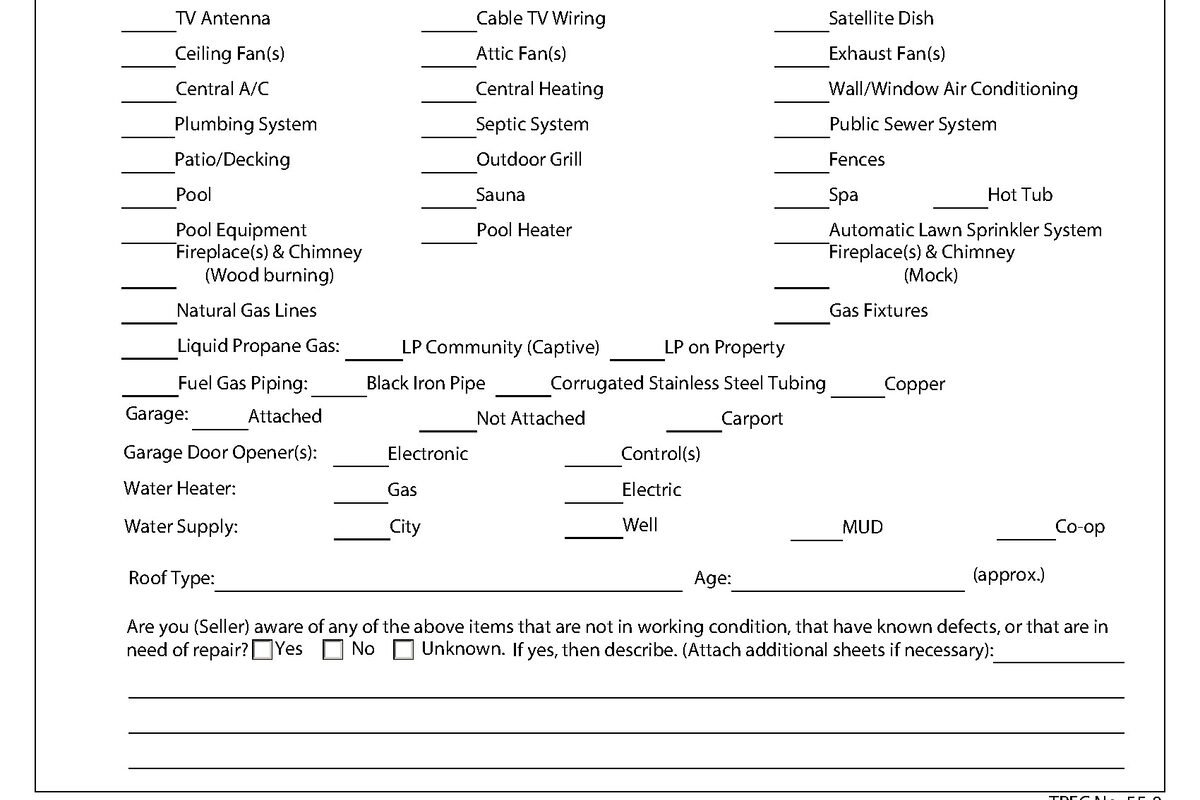
▼The TREC Seller’s Disclosure (OP-H, form 55-0) is the minimum required by Texas law. It’s short, covers the basics, and technically satisfies your legal obligation. The TXR Seller’s Disclosure Notice (form 1406) — published by Texas REALTORS® — is significantly more detailed and is the form used in the vast majority of transactions involving agents.
Here’s the practical reality: if you’re represented by an agent and hand a buyer’s agent the TREC version, they’re going to hand you the TXR version and ask you to fill that out instead. If you’re selling FSBO and don’t have access to the TXR form, the TREC version satisfies the legal requirement. But if you have access to the TXR form, use it — it’s more thorough and saves you the back-and-forth of being asked to complete it later.
Before You Start: This Is YOUR Form
This is a Seller’s Disclosure — not an Agent’s Disclosure and not a Broker’s Disclosure. That distinction matters. Your agent should never coach you on how to answer these questions. If your agent is telling you what to write, what to check, or how to phrase something, those answers stop being your disclosures and start being theirs — and they have nothing to disclose about your property. Agents have their own disclosure obligations — relationships to the parties, relationships with service providers, and if they’re personally buying or selling they must disclose that they hold a real estate license — but the property condition disclosure is yours. The only advice we ever give on this form is: if in doubt, disclose. Beyond that, these are your answers about your property based on what you know.
Section-by-Section Walkthrough
The TXR disclosure is organized into categories. Here’s what each section is asking and where sellers tend to get tripped up.
Structure, Roof, and Walls
This covers the bones of the house — foundation type, roof age and material, exterior walls, interior walls, ceilings, and floors. Be specific. “Roof replaced” means nothing without a date. “Foundation repaired” means nothing without documentation of who did it and what warranty came with it. If you had foundation work done, attach the engineering report. If you replaced the roof, include the year and whether there’s a transferable warranty.
Foundation
Foundation gets its own attention in Texas for obvious reasons. Clay soil, drainage issues, and trees too close to the slab cause more foundation movement here than in most states. Disclose any cracks, previous repairs, drainage systems installed, and whether you’ve ever had a structural engineering report. If the answer is yes, the buyer is going to ask for a copy — have it ready.
HVAC, Plumbing, and Electrical
Age of the systems, any known issues, any repairs or replacements. If your AC unit is 18 years old and still running, say so. Don’t mark it as “working” and leave it at that — “working” and “reliable” aren’t the same thing, and the inspection will reveal the age anyway. For plumbing, disclose the pipe material if you know it (especially if it’s polybutylene or galvanized). Electrical: note the panel brand, any known issues, and whether any work was done without permits.
Appliances
Which appliances convey with the property and their condition. If the dishwasher leaks when you run the heavy cycle, that’s a known defect. Disclose it. A buyer finding out about it during the inspection isn’t better — it’s worse, because now they don’t trust the rest of your disclosure.
Environmental Hazards
Asbestos, lead-based paint, radon, mold, underground storage tanks, and proximity to hazardous waste sites. Federal law requires a separate lead-based paint disclosure for homes built before 1978. The seller’s disclosure form asks about it too — answer both.
Flooding, Drainage, and Water Damage
This is a big one in Houston. The form asks whether the property has ever flooded, whether you’ve filed flood insurance claims, and whether the property is in a floodplain (100-year or 500-year). After Harvey, the legislature added detailed flooding questions. Answer every one of them honestly and completely. If water came into the house — even once, even an inch — disclose it. If you’re in a MUD or PID, those have their own required disclosures as well.
Sell your home for just 1% commission.
HOA Information
If the property is in an HOA, the disclosure asks about dues, special assessments, violations, and deed restrictions. This ties into the HOA resale certificate the title company will order, but the seller’s disclosure is where you state what you know up front. If you’ve received violation notices or know about upcoming assessments, disclose them.
Lawsuits, Liens, and Legal Issues
Pending litigation, code violations, IRS liens, mechanic’s liens, boundary disputes — anything that could affect the buyer’s ownership or use of the property. If there’s a lien you’re aware of, it’s going to show up in the title commitment anyway. Better the buyer hears it from you first.
The Three Mistakes That Cause the Most Problems
Leaving blanks instead of marking “unknown.” A blank is ambiguous. Did you skip it? Did you miss it? Are you avoiding it? The form gives you an “unknown” option for a reason. Use it. Every single question should have a response — yes, no, unknown, or an explanation.
Not updating after conditions change. You filled out the disclosure in January. In March, a pipe bursts in the guest bathroom. If you don’t update the disclosure, you’ve now got a known defect that isn’t reflected in the document. The TXR Update to Seller’s Disclosure Notice exists specifically for this situation. Use it every time a material condition changes between the initial disclosure and closing.
Being vague when a specific answer exists. “Some foundation work” is not a disclosure — it’s an invitation for the buyer to assume the worst. “Perma-Pier installed 12 piers on the south and east sides in 2021, lifetime transferable warranty, engineering report available” is a disclosure. Specificity builds trust. Vagueness destroys it.
Fill It Out Before You Need It
The worst time to complete your seller’s disclosure is the night before listing — or worse, after you already have a buyer asking for it. You’re rushed, you’re stressed, and you’ll forget things or gloss over details that matter.
Sit down when you have no deadline pressure. Walk through the house room by room. Open every cabinet under every sink. Check the attic. Look at the water heater. Think about every repair you’ve ever made or had made. Then fill out the form with that information fresh in your mind.
If you’re working with a listing agent, they should sit down with you and walk through the form question by question before the house hits the market. If they’re not doing that, they’re not doing their job.
Sell your home for just 1% commission.
Disclose, Disclose, Disclose
The three D’s of real estate aren’t a joke — they’re the standard. If you’re wondering whether something needs to be on the disclosure, it probably does. A crack you think is cosmetic. A repair you did yourself. A neighbor dispute that might come up. Water that came in the garage once during a tropical storm.
The goal isn’t to scare buyers away. The goal is to make sure no buyer can come back after closing and say they weren’t told. Honest, complete disclosure protects you more than it protects the buyer. It’s your best defense against post-closing claims, and it’s the right thing to do.
If you’re managing the sale yourself through contract to close, getting the disclosure right is even more critical — you don’t have an agent reviewing it before it goes out.
Related Guides
- Texas Seller’s Disclosure Requirements (Property Code §5.008)
- What Must Sellers Disclose in Texas?
- Lead-Based Paint Disclosure in Texas
- MUD Disclosure in Texas
- PID Disclosure in Texas
- HOA Disclosure and Resale Certificate in Texas
- FSBO Contract to Close
- Discount Realtor Houston: Full-Service Listing for 1%
Frequently Asked Questions
What's the difference between the TREC and TXR seller's disclosure forms?
The TREC Seller's Disclosure (OP-H, form 55-0) is the minimum required by law — it's bare-bones. The TXR form (1406) is far more detailed and is the industry standard used by most agents. If you hand a buyer's agent the TREC version, expect them to send you the TXR version to fill out instead.
Can I just leave a question blank if I don't know the answer?
No. A blank space is not a valid response and can be interpreted as evasion. Every question should be answered with 'yes,' 'no,' 'unknown,' or an explanation. If you genuinely don't know, mark 'unknown' — that's what the option is there for.
Do I need to update my seller's disclosure if something changes after I fill it out?
Yes. If a material condition changes — a pipe bursts, the roof starts leaking, you discover termites — you're obligated to update the disclosure. The TXR Update to Seller's Disclosure Notice is the standard form for this.
What happens if I lie or omit something on the seller's disclosure?
The buyer can pursue legal action after closing for failure to disclose known material defects. Texas courts have awarded damages, repair costs, and attorney's fees in disclosure fraud cases. It's not a theoretical risk — it happens.
When should I fill out the seller's disclosure?
Before you list the property — not the night before, not the morning of. Sit down when you have time to think through every question carefully. If you're working with a listing agent, they should walk you through it before the house hits the market.
