

A Form That Saves You $400-600 at Closing
Every residential real estate transaction in Texas needs a survey. The title company needs it to issue title insurance. The buyer’s lender needs it to verify boundaries. A new survey runs $400-600 in Houston and takes 1-2 weeks. If you already have one and nothing has changed, you don’t need to pay for another.
That’s where the T-47 comes in. It’s a sworn statement — you sign it, and you’re telling the title company, the buyer, and the lender that the existing survey is still accurate. No new fences, no new structures, no boundary changes. Nothing has changed since the surveyor drew that plat.
Simple form. Real consequences if you get it wrong.
Table of Contents
▼What the T-47 Actually Is
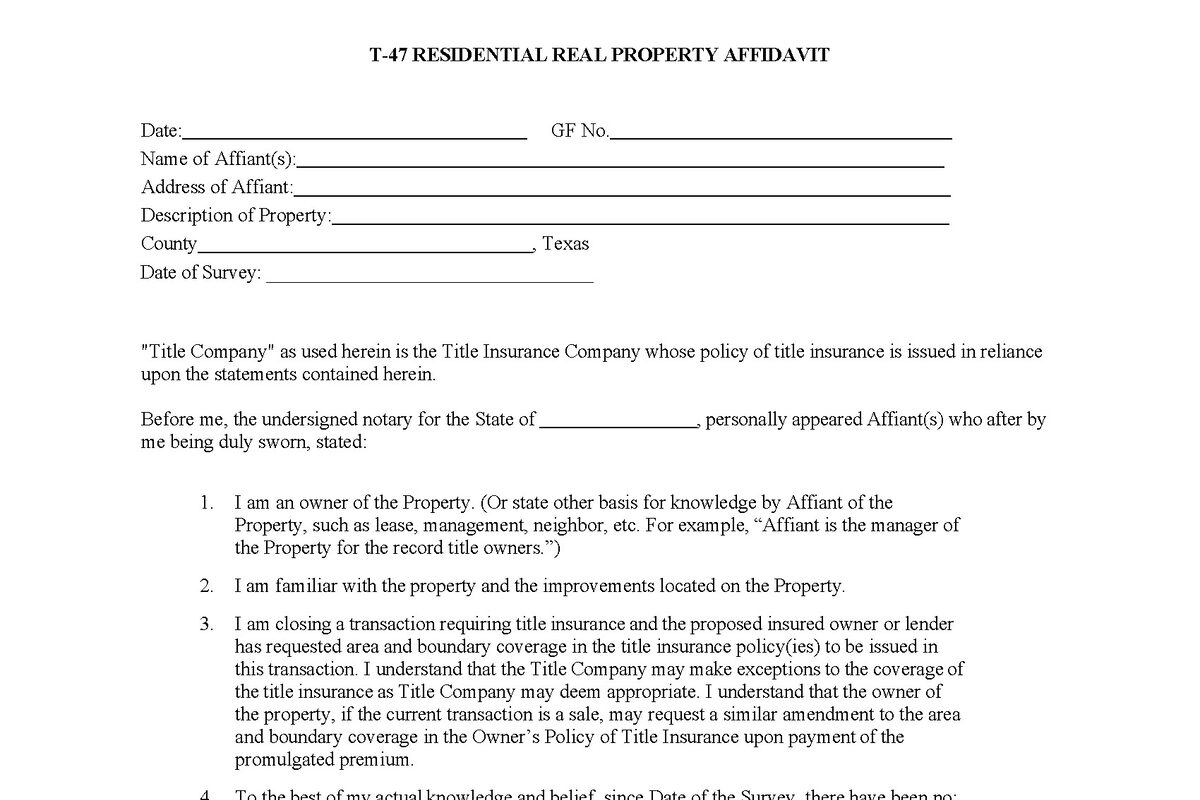
The T-47 Residential Real Property Affidavit (TXR 1907) is a one-page form where the property owner swears that nothing has changed on the property since the date of the existing survey. It’s promulgated by the Texas Department of Insurance and referenced in Paragraph 6C of the TREC 20-18 contract.
When you sign it, you’re confirming:
- No new fences have been built
- No structures have been added — no shed, pergola, patio cover, carport, or room addition
- No swimming pool has been installed
- No changes to driveways, walkways, or retaining walls
- No encroachments from your property onto a neighbor’s or vice versa
- No changes to easements or rights-of-way that you’re aware of
- The property boundaries haven’t changed
This isn’t a casual checkbox. You’re signing under oath. If something did change and you sign anyway, you’ve made a false sworn statement — and you’re potentially liable for anything that goes wrong because the survey was inaccurate.
Two Versions: T-47 Affidavit vs T-47.1 Declaration
There are now two versions of this form, and the difference matters.
T-47 Affidavit — the traditional version. Requires notarization. You sign it in front of a notary public, which means coordinating with the title company or finding a notary before closing.
T-47.1 Declaration — the newer version. Does not require notarization. Same content, same purpose, but you sign it as a declaration under penalty of perjury instead of swearing before a notary.
The TREC contract acknowledges both. Paragraph 6C references “a Residential Real Property Affidavit or Declaration promulgated by the Texas Department of Insurance (T-47 Affidavit or T-47.1 Declaration).” Either one works.
The T-47.1 is more convenient. No notary appointment, no extra step at closing. If your title company offers it, take it. The legal weight is the same — you’re still swearing that nothing changed — but you skip the notarization logistics.
Sell your home for just 1% commission.
When You Need It
You need a T-47 (or T-47.1) when the transaction uses a prior survey instead of ordering a new one. The contract spells this out in Paragraph 6C, which gives several options for how the survey requirement gets handled:
- Buyer provides a new survey at buyer’s expense
- Seller provides an existing survey, and the seller signs a T-47 or T-47.1
- Another arrangement the parties agree to
If you’re providing your existing survey, you’re signing the T-47. It’s the legal bridge between an old survey and a current transaction. Without it, the title company won’t rely on the prior survey and the buyer’s lender won’t accept it.
When You Can’t Sign It
If any of the following happened since the existing survey was completed, you can’t sign the T-47 truthfully. You need a new survey.
You added a pool. Most common one in Houston. If the pool went in after the survey date, the survey doesn’t show it.
You built a fence. Even if you’re confident it’s on your property line, if it’s not on the survey, you can’t swear nothing changed.
You added a patio cover, pergola, deck, or outdoor structure. Anything that wasn’t there when the surveyor came through.
You enclosed the garage or added a room. The building footprint changed.
You put up a shed or detached structure. Even a small storage building counts.
A neighbor built something that might encroach. If the neighbor’s new fence might be on your side of the line, the survey may no longer be accurate.
You’re not sure. If you can’t remember whether the fence was there before or after the survey, don’t guess. A false affidavit has real legal consequences. When in doubt, get a new survey.
The practical rule: if you’ve made any visible improvement to the exterior of the property since the survey date, assume you need a new survey. The $400-600 cost is insignificant compared to a boundary dispute or a title insurance claim that gets denied because your affidavit was wrong.
What Happens If You Sign and Something Changed
If you sign the T-47 and the survey turns out to be inaccurate, several things can go wrong:
Title insurance may not cover the issue. The title company relied on your affidavit when issuing the policy. If the affidavit was false, the insurer can deny claims related to the inaccuracy. That’s the whole point of the form — it shifts the risk to you.
The buyer can seek damages. If a boundary dispute or encroachment surfaces after closing because you swore the survey was current and it wasn’t, the buyer has a claim against you.
The deal can fall apart before closing. If the title company discovers the survey doesn’t match reality during their review, they may refuse to insure the transaction. The buyer may raise objections during the option period. Either way, you’re ordering a new survey under time pressure — and possibly delaying closing.
Most T-47 problems aren’t intentional. Sellers genuinely forget they added a fence six years ago. But the legal exposure doesn’t care about intent.
How the T-47 Fits Into the Closing Timeline
The T-47 gets delivered alongside the existing survey during the title and survey phase of the transaction — typically in the first two to three weeks after the contract is executed. Here’s where it fits in the broader contract-to-close process:
- Contract executed — Day 0
- Title company receives the contract and begins title work
- Seller provides existing survey and signed T-47 (or T-47.1) to the title company
- Title company reviews the survey against the title commitment
- Buyer reviews and raises any objections within the title objection period
Don’t wait until closing week. If you’re using a prior survey, get it to the title company early. If the title company or buyer’s lender has issues with the survey, you want time to resolve them — not a panicked scramble two days before closing.
Tips for Sellers
Find your survey before listing. Check your closing file from when you purchased the home. The survey should be in there. Having it ready saves time once you’re under contract.
Walk the property with the survey in hand. Compare what’s on the plat to what’s actually on the ground. Does every fence, structure, and improvement match? If not, you know you need a new survey before the question even comes up.
Tell your broker if you’ve made changes. A full-service broker can advise whether a T-47 is appropriate or whether you should proactively order a new survey. Getting ahead of this avoids surprises during the title review.
If you can’t find your survey, ask the title company. They may be able to locate one from a previous transaction in their records. Don’t pay for a new one until you’ve checked.
Order early if you need a new survey. Surveyors in Houston can take 1-2 weeks during busy season. A last-minute survey order can delay your closing.
Sell your home for just 1% commission.
The Bottom Line
The T-47 is a straightforward form with a simple purpose — it lets you reuse an existing survey and save $400-600. The newer T-47.1 Declaration makes it even easier by dropping the notarization requirement. But the underlying obligation is the same: you’re swearing that nothing has changed.
If that’s true, sign it and move on. If it’s not — or if you’re not sure — spend the money on a new survey. It’s one of the cheapest forms of protection in a real estate transaction.
For FSBO sellers managing the process without an agent, this is one of those forms that’s easy to overlook until the title company asks for it. Know where your survey is, know whether it’s still accurate, and you won’t be scrambling at the last minute.
Related Guides
Frequently Asked Questions
What is a T-47 Affidavit in Texas?
A T-47 Affidavit is a sworn statement signed by the property owner confirming that nothing has changed on the property since the last survey was completed. It allows the buyer and title company to rely on an existing survey instead of ordering a new one.
What is the difference between a T-47 Affidavit and a T-47.1 Declaration?
Both serve the same purpose — confirming no changes since the last survey. The traditional T-47 Affidavit requires notarization. The newer T-47.1 Declaration does not. The TREC contract references both as acceptable.
Do I need a new survey if I added a fence after the last survey?
Yes. If you added a fence, pool, patio cover, shed, room addition, or any other structure after the survey date, you cannot truthfully sign the T-47. You need a new survey.
How much does a new residential survey cost in Texas?
A new residential survey in the Houston area typically costs $400-600 depending on lot size and complexity. This is the cost the T-47 Affidavit helps you avoid when nothing has changed since the last survey.
Who pays for the survey in a Texas real estate transaction?
The contract determines who pays. Paragraph 6C of the TREC contract gives three options: buyer pays, seller pays, or another arrangement. In Houston, buyers typically pay for a new survey if one is needed.
