

What You’re Actually Signing When You List Your Home
Every home sale in Texas starts with a listing agreement. It’s the contract between you — the seller — and your broker that authorizes them to market and sell your property. It defines what the broker will do, what you’ll pay, how long you’re committed, and what happens if things don’t work out.
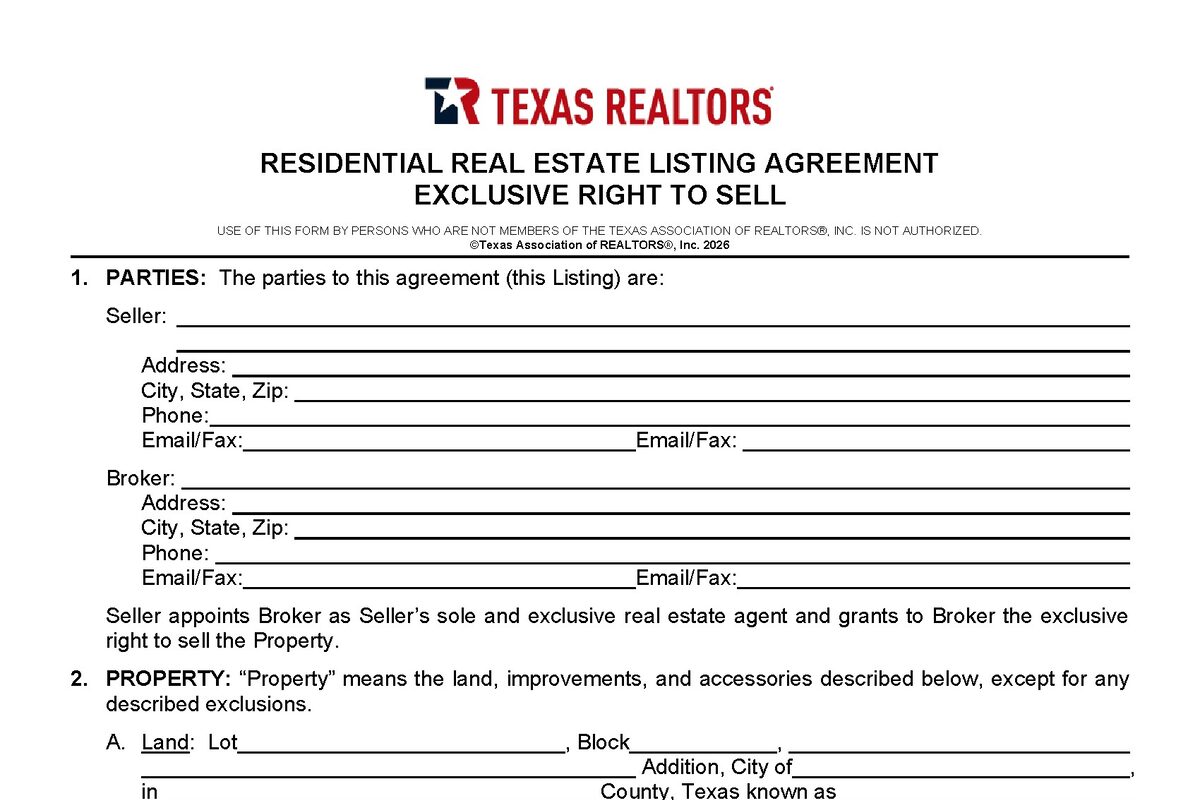
The form most brokers use is the TXR Residential Real Estate Listing Agreement — Exclusive Right to Sell (formerly known as TAR 1101). It’s a standard form published by Texas Realtors, but the terms inside are not standard. Every blank on that form is negotiable, and what gets filled in determines the deal you’re making with your broker.
Most sellers sign this document in 10 minutes without reading it. That’s a mistake. Here’s what every section means in plain English.
Table of Contents
▼Types of Listing Agreements
Before we get into the sections, you should know there are three types of listing agreements in Texas:
Exclusive Right to Sell — the broker earns a commission no matter who finds the buyer. If your neighbor knocks on your door and makes an offer, your broker still gets paid. This is the most common type by far — it’s what 99% of sellers sign, and it’s the form we’re breaking down in this article.
Exclusive Agency — the broker earns a commission only if they or another agent bring the buyer. If you find a buyer on your own with no agent involvement, you don’t owe the broker anything. These are rare because most brokers won’t agree to them.
Open Listing — no exclusive relationship. You can list with multiple brokers simultaneously and only pay the one who brings the buyer. These are uncommon in residential real estate and typically used in commercial transactions.
For the rest of this article, we’re focused on the Exclusive Right to Sell — because that’s what you’re almost certainly going to sign.
Commission Rate and When It’s Earned
This is the section everyone looks at first, and for good reason. The commission rate is what you pay the listing broker at closing for their services.
There is no standard commission rate in Texas. It’s negotiable — always has been, always will be. If a broker tells you “the standard rate is X%,” they’re telling you their rate, not an industry standard. Commission rates vary widely depending on the brokerage model, and you should understand the differences before you commit.
The agreement also defines when the commission is earned. In most cases, it’s earned when the broker procures a buyer who is ready, willing, and able to purchase on the terms in the agreement — or on terms you accept. This matters because in some situations the commission can be owed even if the sale doesn’t close. Read this section carefully and ask your broker to explain the specific scenarios where commission is due.
Duration and Term
The listing agreement has a start date and an end date. That’s how long you’re committed. During this period, the broker has the exclusive right to market and sell your property.
Common terms at traditional brokerages range from 90 days to 12 months, with six months being typical. A listing agreement can be terminated by either side — you’re not trapped — but shorter terms make the relationship easier to evaluate for everyone involved.
We use 30-day listing agreements and renew just before expiration. Every 30 days, both sides get a natural checkpoint to evaluate progress — is the pricing strategy working, are we getting showings, does the marketing need adjustment? For sellers who are conflict-avoidant or uncomfortable with the idea of being locked into a long commitment, this makes a huge difference. You’re never stuck wondering how to get out of a 12-month agreement with a broker who isn’t performing.
If a broker insists on a long term and won’t budge, ask why. A broker who’s confident in their service doesn’t need to lock you in.
Cancellation and Default
Can you get out of a listing agreement if things aren’t working? The TXR listing agreement doesn’t include a standard cancellation clause — it uses a default framework. Under Paragraph 16, if either side breaches the agreement, the other side has remedies. If the seller stops cooperating, the broker can terminate and may be owed their commission. If the broker breaches, the seller can exercise remedies at law.
In practice, most brokers will release a seller who genuinely wants out — forcing someone to stay in a listing agreement they’re unhappy with doesn’t lead to a successful sale. But the terms of that release are up to the broker, and some will require reimbursement for marketing expenses already incurred.
When both sides agree to part ways, the TXR-1410 Termination of Listing form makes it official. It terminates the agreement, specifies any termination fees owed to the broker, and — importantly — releases both parties from all obligations including the protection period. The form requires the seller to represent that there are no pending negotiations, so it can’t be used while you’re under contract with a buyer.
This is why the term length matters. A 30-day agreement that renews gives both sides a natural exit point without anyone needing to invoke the default clause or negotiate a termination. A 12-month agreement means you’re relying on the broker’s willingness to sign a TXR-1410 if things aren’t working.
At Creekstone, we’re open to termination at any time the seller isn’t under contract — no hard feelings. That’s part of why we do 30-day agreements with frequent renewals. If we’re not performing for you or you’ve changed your mind about selling, we’d rather part ways on good terms than hold you to a contract you don’t want to be in.
For a deeper dive on this, read our guide on whether you can cancel a listing agreement in Texas.
Services Included
The TXR listing agreement itself is surprisingly vague on specific services. Paragraph 11 says the broker will “use reasonable efforts and act diligently to market the Property for sale, procure a buyer, and negotiate the sale of the Property.” That’s broad — it doesn’t spell out photography, showing coordination, or contract management.
What you actually get depends on your broker. This is where the difference between a limited service and full service listing matters — and it’s a conversation you need to have before you sign, because the standard form won’t answer it for you.
Ask your broker specifically what’s included: Who handles photography? How are showings coordinated? Who manages the transaction from contract to close? What happens when an inspection report comes back? If the broker can’t give you clear answers, that tells you something about the level of service you’re signing up for.
Some brokers use Paragraph 15 (Special Provisions) to add specific service commitments to the agreement. If your broker offers to do that, it’s a good sign — they’re willing to put their promises in writing.
Protection Period
This one catches sellers off guard. The protection period is a window of time after your listing agreement expires during which the broker may still be owed a commission. At some brokerages, this can be 90 to 180 days — meaning you’re looking over your shoulder for six months after the relationship ended.
Here’s how it works: if a buyer was introduced to your property during the listing term and that buyer purchases the property within the protection period, the broker’s commission is still due. The idea is to prevent sellers from waiting out the listing term and then selling to a buyer the broker’s marketing brought in.
Most protection periods include an exception: if you relist with another broker and that buyer purchases through the new broker, the original broker’s protection period doesn’t apply. But the specifics matter — read the language in your agreement.
We do a 30-day protection period. If a seller didn’t want to continue working with us, chasing them around for months looking for a commission check isn’t how we want to spend our time — and it’s not how we want to end a relationship. We have other sellers who need our attention, and everyone should be working together, not against each other.
Who Pays for What
The agreement should define who covers marketing expenses. Some brokers include everything — photography, signage, lockbox, digital marketing — in the commission. Others charge separately for some or all of these.
Ask these questions before signing:
- Is professional photography included or extra?
- Who provides and pays for the yard sign?
- Who provides the lockbox?
- Are there any upfront fees or marketing charges?
- If the listing doesn’t sell, do I owe anything?
At Creekstone, everything is included in the 1% commission. Here’s how we make that work.
Buyer Agent Compensation
Your listing agreement addresses how much compensation is offered to the agent representing the buyer. This is separate from what you pay your listing broker — it’s the amount offered through MLS to incentivize buyer’s agents to show your property.
This is a negotiable number. Who pays realtor fees in Texas and how those fees are structured has changed significantly in recent years. Your broker should walk you through how buyer agent compensation works, what’s typical in your area, and how the amount you offer can affect your pool of buyers.
Seller’s Obligations
The listing agreement isn’t just about what the broker does — it also defines what you’re responsible for as the seller. Common obligations include:
- Making the property available for showings during the listing term
- Providing required disclosures (seller’s disclosure, lead-based paint, etc.)
- Cooperating with the broker’s marketing efforts
- Notifying the broker of any material changes to the property
- Not entering into another listing agreement during the term
These obligations are reasonable, but you should understand them. If you can’t accommodate showings because of a work schedule or tenant situation, discuss that with your broker before signing — not after.
What to Look for Before You Sign
Before you put your name on any listing agreement, ask these questions:
- What is the commission rate, and is it negotiable? If the broker says no, keep shopping.
- How long is the term? Don’t sign a 12-month agreement unless you have a specific reason to.
- What are the cancellation terms? Know your exit options before you need them.
- What services are included? Get specifics — not generalities. If “full service” doesn’t come with showing coordination, it’s not full service.
- What is the protection period? How long, and what are the exceptions?
- What upfront costs are there? Photography, signs, marketing fees — who pays?
- How much buyer agent compensation is being offered? And how does that affect your total cost?
A broker who’s transparent about their agreement will answer every one of these without hesitation.
How Creekstone Handles the Listing Agreement
Our listing agreement is a full-service Exclusive Right to Sell. It includes everything — professional photography, MLS listing, showing coordination, offer negotiation, inspection guidance, and contract-to-close management through funding. All at 1% commission.
The agreement is in plain English and we make a sample copy available for you to review on your own time before you commit to anything — so you can compare it against any other agreement you’re considering. We also provide a one-pager that covers the most common questions. If anything isn’t clear, we’re happy to answer questions.
If you want to see what a full-service listing agreement looks like before you sign with anyone, reach out and we’ll send you a copy. No commitment, no follow-up calls. Just a real agreement you can read, mark up, and bring questions back on.
Related Guides
- Limited Service vs Full Service Listing in Texas
- Can You Cancel a Listing Agreement in Texas?
- How Realtor Commissions Are Split in Texas
- Who Pays Realtor Fees in Texas?
- Discount Realtor Houston: Full-Service Listing for 1%
- How Can a Realtor Charge 1% and Still Provide Full Service?
- Download the Commission Comparison Checklist
- Ready to Sell? Start Here
Selling a Home in Houston?
1% listing fee. Full service. No long-term contract.
Frequently Asked Questions
What is the TXR Residential Real Estate Listing Agreement?
It's the standard contract between a Texas home seller and their listing broker. It authorizes the broker to market and sell your property, defines the commission rate, the services included, the duration of the agreement, and each party's obligations.
Can I negotiate the commission rate in a listing agreement?
Yes. Commission rates are always negotiable — there is no standard or required rate in Texas. The rate you see on the agreement is whatever you and the broker agreed to. If a broker tells you otherwise, that's a red flag.
What is the protection period in a listing agreement?
The protection period is a window of time after your listing agreement expires during which the broker may still be owed a commission. If a buyer they introduced during the listing term purchases your home within that window, the broker's commission is still due.
Can I cancel a listing agreement in Texas?
The TXR listing agreement doesn't have a standard cancellation clause — it uses a default framework. In practice, most brokers will release a seller who wants out, but the terms of that release are up to the broker. This is why the term length and your broker's policies matter — a shorter agreement gives you a natural exit without needing to negotiate a release.
What's the difference between Exclusive Right to Sell and Exclusive Agency?
With Exclusive Right to Sell, the broker earns a commission no matter who finds the buyer — even if you find them yourself. With Exclusive Agency, the broker only earns a commission if they or another agent bring the buyer. Exclusive Right to Sell is what 99% of Texas sellers sign.
