

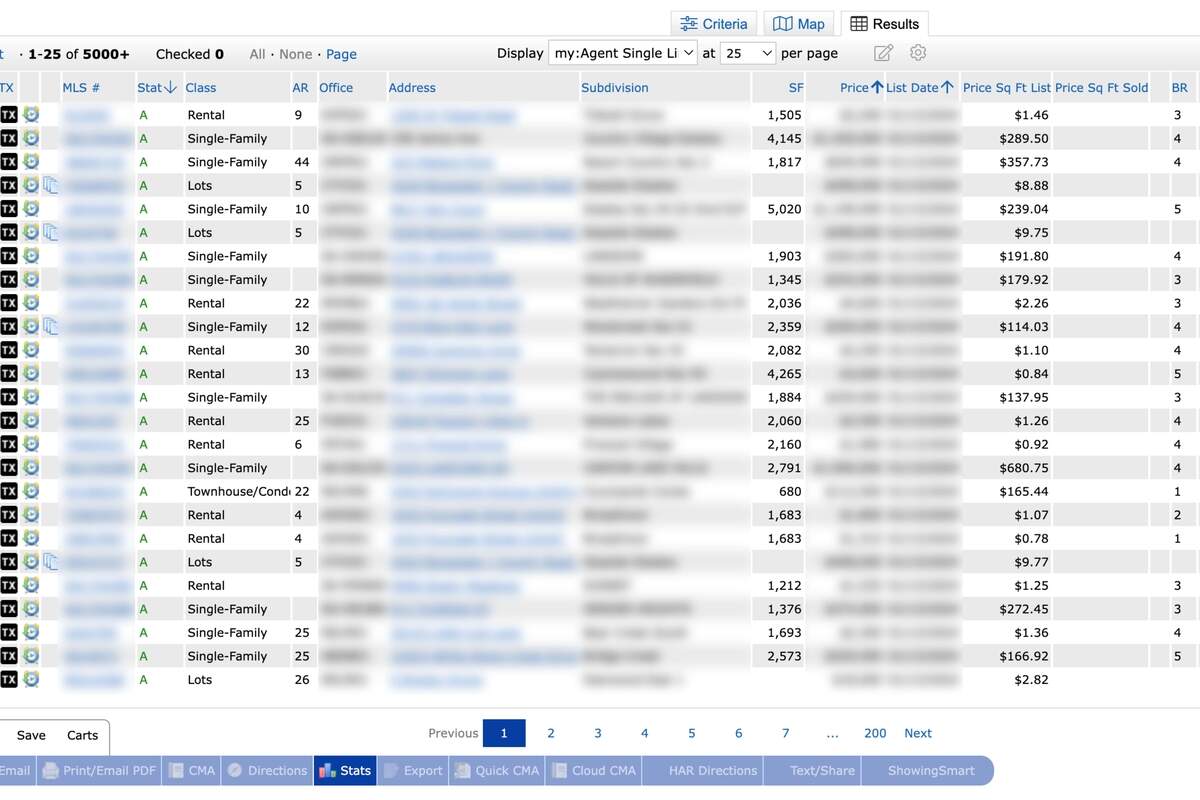
What Does MLS Stand For?
MLS stands for Multiple Listing Service. It’s the private database that Realtors use to share property listings with each other. When your home is listed on MLS, it becomes visible to every Realtor in your market area and gets syndicated to consumer-facing sites like HAR.com, Zillow, Realtor.com, and Redfin.
If you’re selling a home in Houston, MLS exposure is the single most important factor in getting your property in front of qualified buyers.
In this guide
How MLS Works
MLS is pretty straightforward: Realtors and brokers agree to share their listings with each other through MLS so everyone’s clients benefit from a larger pool of properties for sale.
Here’s what happens when your home gets listed:
- Your listing agent enters your property details into MLS — photos, price, square footage, room counts, property description, showing instructions, and the compensation being offered to buyer’s agents.
- Every Realtor in the MLS network can now see your listing — they can search for properties matching their buyer’s criteria and your home shows up in those results.
- Automated alerts fire off — buyers who have saved searches with their agents or on MLS portals get notified that a new listing matching their criteria just hit the market.
- Syndication kicks in — your listing data flows out to HAR.com, Zillow, Redfin, Realtor.com, and dozens of other real estate websites, usually within 24 to 48 hours.
- Showing requests start coming in — buyer’s agents contact your listing agent (or use a showing scheduling service) to book appointments.
MLS is a cooperative system and it relies on brokers, listing agents, and buyer’s agents to do their part to help serve buyers and sellers.
Who Can Access MLS?
MLS access is restricted to Realtors — licensed agents and brokers who are dues-paying members of a local Realtor association. In Houston, that means membership in HAR.
As a homeowner, you cannot directly log in to MLS or enter your own listing. You need a Realtor to do it for you.
There are a few ways to get your home on MLS:
- Full-service listing — an agent lists your property and handles the entire transaction — pricing, marketing, showings, negotiation, and closing — for a commission you negotiate up front. This is what we do at Creekstone Real Estate.
- Flat fee MLS listing — a broker enters your listing into MLS for a flat upfront fee and you handle the rest yourself. This can work, but there are situations where flat fee MLS isn’t the right fit.
Regardless of which route you choose, the MLS exposure is the same. Every listing entered into HAR MLS gets the same visibility to agents and the same syndication to consumer websites. Want to understand the differences? Here’s our comparison of flat fee MLS listings vs traditional listings.
How Many MLS Systems Are There?
There are roughly 580 MLS systems in the United States, each serving a specific geographic area. They are not connected to each other — a listing entered into the Houston MLS does not automatically appear in the Dallas MLS or the Austin MLS.
Houston’s MLS is operated by HAR, which originally stood for the Houston Association of Realtors. In 2015, HAR rebranded to “Homes and Rentals” and expanded from a Houston-area association to a statewide organization covering all of Texas. That’s a massive change — it means HAR MLS now represents over 50,000 Realtor members and 164,000 real estate agents and brokers across the state, with 147,000+ property listings and coverage of 20,000+ neighborhoods. HAR.com regularly ranks in the top 20 national real estate websites and is the most successful consumer-facing Realtor association website in the country.
For Houston-area sellers, this expansion is a big deal. Your listing doesn’t just reach Houston-area agents anymore — it’s visible to Realtors across the entire state of Texas.
What Is an MLS Number?
Every property listing that enters MLS gets assigned a unique identification number. This is your MLS number (sometimes called a listing ID).
Agents use the MLS number to quickly pull up a specific property, and it’s the number your buyer’s agent will reference when writing an offer or scheduling a showing. If someone asks you for your MLS number, it’s on your listing sheet and your agent can provide it.
How Do Zillow and Redfin Get MLS Data?
Once your listing agent or broker sets the listing to Active, it takes a little time for different websites to update with the latest data.
- HAR.com — usually within 2 to 4 hours
- Zillow, Redfin, Realtor.com — typically within 24 to 48 hours
- Secondary portals — may take a few days depending on where they source their data
Listing syndication is normally on by default and it requires deliberate steps to disable it. Syndication means more visibility, which translates into more buyers seeing your listing. We leave it on for every listing we manage.
HAR publishes a full list of where your listing data gets distributed — it’s a long list. You can also see an overview on HAR’s listing distribution page. The reach is significant, and it’s one of the biggest reasons MLS exposure matters.
Do Realtors Have to Pay for MLS?
Yes. We pay quarterly dues to maintain MLS access. At the brokerage level, we pay just over $1,900 per year for the broker and brokerage HAR MLS account. That doesn’t include NAR (National Association of Realtors) and TAR (Texas Association of Realtors) dues, which are also required. Each individual Realtor in the brokerage pays for their own MLS account on top of that.
And then there’s the Supra eKey — about $16.50 a month if you want to use electronic lockboxes for listings or access lockboxes to show properties. It adds up. MLS access is not inexpensive, but it’s the cost of doing business in real estate.
Why MLS Matters When Selling Your Home
Listing your property on MLS is the single most effective way to sell a home. According to HAR’s own data, HAR.com is one of the top 20 real estate websites in the country, representing 164,000 agents and brokers and over 147,000 active listings. That’s the network your listing plugs into the moment it goes Active.
Without MLS, you’re limited to yard signs, social media, and word of mouth. With MLS, your listing reaches every active Realtor in the state, every buyer with a saved search on HAR.com, and millions of visitors on Zillow, Redfin, and Realtor.com through syndication.
Is a Flat Fee MLS Listing as Effective as a Traditional Listing?
Yes, a flat fee MLS listing appears in MLS exactly the same as a traditional listing. Buyer’s agents searching for properties see it right alongside every other listing — there’s no flag or indicator that it’s a flat fee listing.
The difference isn’t in exposure — it’s in service. With a flat fee listing, you typically handle showings, negotiations, and paperwork yourself. With a full-service listing, your broker handles those for you.
If you’re considering your options, here’s our take on whether flat fee MLS is legal and when not to use a flat fee MLS listing.
If you’re selling a home in Houston, getting on HAR MLS is non-negotiable — it’s where the buyers are. The question isn’t whether to list on MLS, it’s how much help you want once you’re there. A full-service listing gives you the same MLS exposure plus someone handling showings, offers, and paperwork — and keeping you updated — through closing.
Related Seller Guides
Frequently Asked Questions
What does MLS stand for?
MLS stands for Multiple Listing Service. It is a private database used by Realtors to share property listings and cooperate on sales.
Can anyone access MLS?
No. MLS access is restricted to Realtors — licensed agents and brokers who are members of a local Realtor association. Consumers can view MLS data indirectly through sites like HAR.com, Zillow, and Realtor.com.
How many MLS systems are there in the United States?
There are roughly 580 MLS systems operating across the United States. Each one serves a specific geographic area, and listings do not automatically transfer between them.
What is an MLS number?
An MLS number is a unique identifier assigned to every property listing when it enters the MLS database. Agents, buyers, and sellers use it to reference a specific listing.
How does a flat fee MLS listing work?
A flat fee MLS listing allows a homeowner to pay a fixed fee to have their property entered into MLS by a licensed broker, giving the listing the same exposure as a traditional full-commission listing.
How do Zillow and Redfin get their listings?
Zillow, Redfin, Realtor.com, and other real estate portals receive listing data through syndication feeds from MLS systems. When a listing goes active in MLS, it typically appears on these sites within 24 to 48 hours.
Selling a Home in Houston?
Full-service listing, with regular updates once you're live.
- Professional Photos
- HAR MLS Listing
- Showing Coordination
- Contract Negotiation
- Closing Support
- 4.94★ on HAR
How We Sell Homes Get Your Free Market Analysis Try the Seller Net Sheet