

What Must Sellers Disclose in Texas?
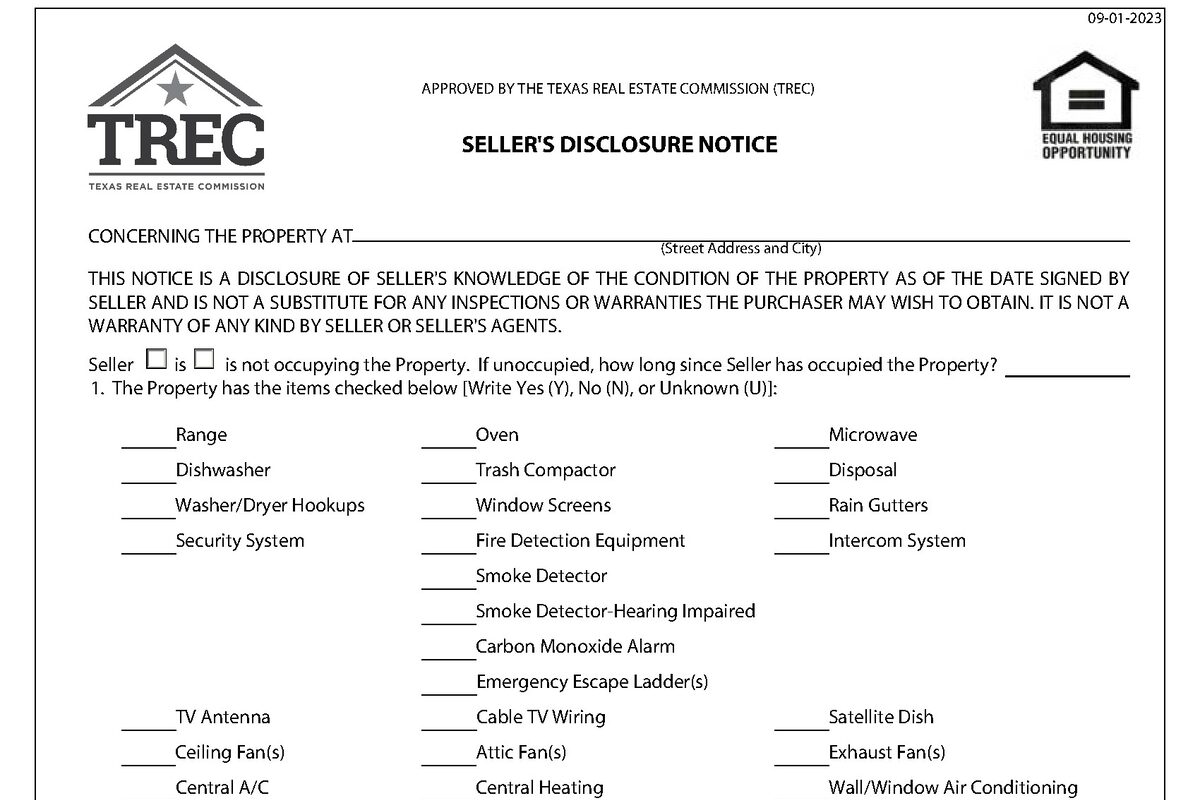
Texas law is clear: Section 5.008 of the Texas Property Code requires sellers of residential property to provide a written disclosure of what they know about the condition of the home. The statute even includes a minimum disclosure form. It’s not optional. It’s not something your agent handles for you. You sit down, go through the form, and answer honestly about every system, every defect, and every repair you’re aware of.
The disclosure is one of the first documents you’ll complete when listing, and it’s one of the most important. Get it right and it protects you. Get it wrong — or skip something — and it follows you long after closing.
Table of Contents
▼Your Agent Does Not Fill This Out for You
This is a Seller’s Disclosure — not an Agent’s Disclosure and not a Broker’s Disclosure. That distinction matters. Your agent should never coach you on how to answer these questions. If your agent is telling you what to write, what to check, or how to phrase something, those answers stop being your disclosures and start being theirs — and they have nothing to disclose about your property. Agents have their own disclosure obligations — relationships to the parties, relationships with service providers, and if they’re personally buying or selling they must disclose that they hold a real estate license — but the property condition disclosure is yours. The only advice we ever give on this form is: if in doubt, disclose. Beyond that, these are your answers about your property based on what you know.
If at any point during a transaction we become aware that a seller has underdisclosed — left something out or misrepresented a condition — we stop immediately. We require the seller to update the disclosure mid-transaction and notify the other party. If we’re not yet under contract, we require them to complete an Update to Seller’s Disclosure Notice before we proceed. If they refuse, we’ve dropped clients before. We won’t tolerate it. The three D’s aren’t a suggestion — they’re how we operate.
The Legal Foundation: Texas Property Code Section 5.008
Texas Property Code Section 5.008 requires sellers of residential property (one to four units) to provide a written disclosure notice to the buyer. The form covers the condition of the property, known defects, and material facts that could influence a buyer’s decision.
The key word is known. You’re not required to hire an inspector or go looking for problems. The form asks about the current condition of the property and material issues you’re aware of. Not every repair over the life of the house needs to be listed — a fixed squeaky door or a replaced faucet isn’t a disclosure item. But significant issues that could affect a buyer’s decision — that’s what the form is for. When in doubt, disclose.
For a detailed walkthrough of the form itself, see our guide to the Texas seller’s disclosure. You can also download our Texas Seller’s Disclosure Guide for a section-by-section reference.
Two Versions of the Disclosure Form
This is where sellers — and some agents — get tripped up. There are two versions of the seller’s disclosure form used in Texas:
TREC Form 55-0 — the statutory minimum. It’s lean, covers the basics, and satisfies the legal requirement under Section 5.008. It asks straightforward yes/no/unknown questions about the property’s systems and condition.
TXR Seller’s Disclosure (formerly TAR) — the industry standard. This form is significantly more detailed, with expanded questions about property history, repairs, environmental conditions, and specific systems. It gives the buyer a much more complete picture of what they’re buying.
Here’s the reality: if a listing agent hands a buyer’s agent the TREC version, expect the buyer’s agent to send over the TXR form and ask you to complete it instead. If you’re selling FSBO and don’t have access to the TXR version, the TREC form satisfies the legal requirement — it’s perfectly valid. But if you’re represented by an agent and still using the TREC version, the buyer’s side is going to wonder why.
What You’re Required to Disclose
The disclosure covers every major system and condition of the property. Here’s the breakdown:
Structural and Foundation
Foundation condition is the big one in Houston. If you’ve had foundation work done — piers, leveling, mudjacking — disclose it. Include who did the work, when, what was done, and whether there’s a transferable warranty. If you’ve noticed cracks in the walls, doors that stick, or floors that slope, disclose it. Houston’s expansive clay soil means foundation movement is common, and buyers expect transparency here.
Roof age, condition, leaks, and repairs. Wall cracks. Window and door issues. Any structural modifications you’ve made to the home.
Mechanical Systems
HVAC age and condition, past problems, and repairs. If the AC struggles every August and you’ve been nursing it along with duct tape and optimism, the buyer needs to know. Plumbing — leaks, water heater age, sewer line issues, water damage past or present, repaired or not. Electrical system condition, panel age, known issues.
Appliances
Any appliances staying with the property — their condition, known issues, and age. If the dishwasher floods the kitchen every third cycle, that goes on the disclosure.
What Triggers Additional Disclosures
The seller’s disclosure is the main event, but several situations trigger separate, additional disclosure forms:
- MUD (Municipal Utility District) — if the property is in a MUD, the buyer must receive a specific MUD notice disclosing the district’s tax rate and obligations
- PID (Public Improvement District) — similar to MUD, PIDs carry additional assessments that must be disclosed
- HOA/POA — if the property is governed by a homeowners association or property owners association, the buyer is entitled to the HOA resale certificate showing dues, violations, reserves, and governing documents
- Lead-based paint — federally required for all homes built before 1978, regardless of sale type or exemptions
- Flood zone — whether the property is in a special flood hazard area, flood insurance history, and any previous flooding. If you’re selling FSBO and need to check your flood zone, see our guide to special flood hazard areas which includes free lookup tools for Houston-area counties
- Coastal area — properties near the Texas coast have additional disclosure requirements
- Fixture leases — solar panels, water softeners, propane tanks, or any leased equipment attached to the property must be disclosed so the buyer knows they’re assuming a lease obligation
Missing any of these is a problem that doesn’t resolve itself after closing. If you’re not sure which additional disclosures apply to your property, your broker should be reviewing this with you before the listing goes live.
Timing: When Does the Buyer Get the Disclosure?
Best practice is to have the disclosure completed before you list and available to buyers before they write an offer. Most listing agents include it in the MLS document package so buyer’s agents can review it during showings.
If the buyer doesn’t receive the disclosure before signing the contract, they have 7 days after receiving it to terminate the contract for any reason. That’s a contractual right — and it gives the buyer a free exit that you don’t want to hand them after you’ve already gone under contract.
Get the disclosure done early. Have your broker review it. Make it available from day one. This protects you and keeps the transaction moving forward without unnecessary termination windows.
The Seller’s Disclosure Is Not a Warranty
This trips sellers up regularly. The disclosure is your honest representation of what you know about the property at the time you complete it. It is not a guarantee that everything works, and it’s not a warranty that nothing will break after closing.
If the HVAC was working when you completed the form and it dies two weeks later, you haven’t done anything wrong — as long as it was genuinely working when you signed. You’re disclosing current knowledge, not predicting the future.
That said, if something changes between your initial disclosure and closing, you need to address it. The TREC 1-4 contract (Paragraph 10A) requires you to deliver the property in its present or required condition, ordinary wear and tear excepted. If the water heater starts leaking after you’ve already given the buyer your disclosure, you fix it — you’re obligated to deliver the property in the condition it was when contracted. Then update the disclosure to note the issue and the repair. The TXR has a specific form for updated disclosures.
Common Things Sellers Forget to Disclose
In my experience, these are the items that get left off most often:
- Prior flooding — even minor water intrusion that didn’t result in an insurance claim. This is Houston. If your house has taken water, the buyer will eventually find out.
- Insurance claims — past claims for hail, wind, water, or fire damage. Buyers can pull a CLUE report, so this information is discoverable whether you disclose it or not.
- Foundation repair history — especially if it was done by a previous owner and you inherited the warranty documentation
- HOA violations — any active violations should be resolved before closing or disclosed to the buyer
- Easements — utility easements, drainage easements, or access agreements that affect the property
- Environmental issues — old underground storage tanks, soil contamination, proximity to industrial sites
If you’re not sure whether something belongs on the disclosure — when in doubt, disclose.
What Happens If You Don’t Disclose
Problems don’t go away at closing. According to Texas REALTORS®, failure to disclose or misrepresent material information may expose sellers to liability under the Deceptive Trade Practices Act and other civil laws. If the disclosure isn’t delivered on time, the buyer may have the right to terminate the contract and receive a refund of their earnest money.
For specific legal questions about disclosure obligations and potential consequences, consult a real estate attorney.
Tips for Completing the Disclosure
Take your time. Go room by room, system by system. Think about the entire time you’ve owned the property — not just what’s happening right now.
Don’t leave blanks. A blank section is an incomplete disclosure — and if you’re working with us, we’ll send it back for you to finish. “Unknown” is a valid answer if you genuinely don’t know. Blank is just incomplete.
For significant repairs, include the details. If you had foundation work, a roof replacement, or a major plumbing repair, note what was done, who did it, and when. Keep receipts and invoices. You don’t need to list every faucet you replaced — but major work that a buyer would want to know about should be documented.
Be specific. “Foundation repaired” is less helpful than “Foundation leveled by ABC Foundation Co. in 2019, 12 piers installed, transferable lifetime warranty.” Specificity builds trust with buyers and their agents.
Have your broker check it for completeness. We don’t review your answers — those are yours — but we do check that every section is filled in and flag anything that might trigger additional disclosures (lead-based paint for pre-1978 homes, flood zone, MUD/PID, etc.). If you’re selling FSBO, nobody is doing that check for you.
Who Is Exempt from Seller Disclosure?
Section 5.008 of the Texas Property Code lists specific exemptions:
- Foreclosure sales — the lender selling a foreclosed property
- Estate sales — executor or administrator selling on behalf of a deceased owner’s estate
- Court-ordered sales — bankruptcy, divorce decree, etc.
- Transfers between co-owners or spouses
- Transfers to or from a trust
- New construction — never occupied (the builder has separate disclosure obligations)
Even with these exemptions, the federal lead-based paint disclosure still applies to all pre-1978 homes regardless of sale type.
A note about estate sales: The exemption exists because the executor technically didn’t live in the property. But here’s the reality — a lot of the time the executor is the adult child of the deceased. They grew up in that house. They visited every Christmas. They know the roof leaked in 2018 and the HVAC was replaced in 2015. Just because the law may not require the disclosure doesn’t mean you shouldn’t provide one. If you know things about the condition of the property, disclose them. When we take an estate listing, we first establish the executor’s relationship to the deceased. If they’re a child, family member, or close friend — someone who spent time in the property and knows its history — we ask for a disclosure. They can note their relationship on the form. If they refuse, we decline the listing. Not all money is good money. Obviously, if the executor is a court-appointed attorney who’s never set foot in the property, there’s nothing useful to disclose and we don’t push for one.
If you’re not sure whether your situation qualifies for an exemption, consult a real estate attorney. Most standard residential resale transactions require the full disclosure.
The Bottom Line
If you’re not catching the drift of this article, it’s this: we take disclosure seriously. We enjoy working with people who have an equal respect for the truth and honest dealings. If that’s you, we’ll get along great.
The seller’s disclosure isn’t something to dread — it’s something to get right. Be honest, be thorough, and when you’re on the fence about whether to include something, include it. Disclose, disclose, disclose.
A complete, accurate disclosure builds trust with buyers and keeps the transaction moving forward without surprises. It’s one of the simplest things you can do to make the whole process smoother for everyone.
Related Guides
- Texas Seller’s Disclosure and You
- Lead-Based Paint Disclosure in Texas
- MUD Disclosure in Texas
- PID Disclosure in Texas
- HOA Disclosure and Resale Certificate in Texas
- Fixture Leases Disclosure in Texas
- FSBO Contract to Close: What to Expect
- Discount Realtor Houston: Full-Service Listing for 1%
- Download the Texas Seller’s Disclosure Guide
- Ready to Sell Your Home?
Selling a Home in Houston?
1% listing fee. Full service. No long-term contract.
Frequently Asked Questions
What are sellers required to disclose in Texas?
Under Texas Property Code Section 5.008, sellers must provide a written disclosure notice covering known material defects and conditions — structural, mechanical, environmental, and flood-related. This includes past repairs, insurance claims, and anything that could affect a buyer's decision.
What's the difference between the TREC and TXR seller's disclosure forms?
The TREC form (55-0) is the statutory minimum — lean and basic. The TXR form (formerly TAR) is far more detailed and is the industry standard used by most listing agents. If you're selling FSBO, you may not have access to the TXR version and the TREC form is perfectly valid. But if you're represented by an agent and they hand the buyer's side the TREC version, expect the buyer's agent to send over the TXR form and ask you to complete that instead.
Do I still have to complete a disclosure if the house is sold as-is?
Yes. Under the TREC 1-4 contract, all homes are sold as-is — that's built into the contract. But as-is doesn't exempt you from disclosure. You still have to complete the Seller's Disclosure Notice and tell the buyer everything you know about the property's condition. And even though the contract says as-is, repairs can still be negotiated — a lot of people don't realize that.
What happens if I don't disclose a known defect in Texas?
According to Texas REALTORS®, failure to disclose or misrepresent material information may expose sellers to liability under the Deceptive Trade Practices Act and other civil laws. If the disclosure isn't delivered on time, the buyer may have the right to terminate and get their earnest money back.
Do I have to disclose foundation repairs in Texas?
Yes. If you know about foundation problems — past or present — you must disclose them. That includes previous repairs, who did the work, when it was done, and any transferable warranty. Foundation issues are a big deal in Houston and buyers take them seriously.
